Aviation Phonetic Alphabet: ICAO/NATO Pronunciation
By Renzo Madueño, former Airbus A320 First Officer (Avianca), FAA commercial pilot · Updated October 3, 2026
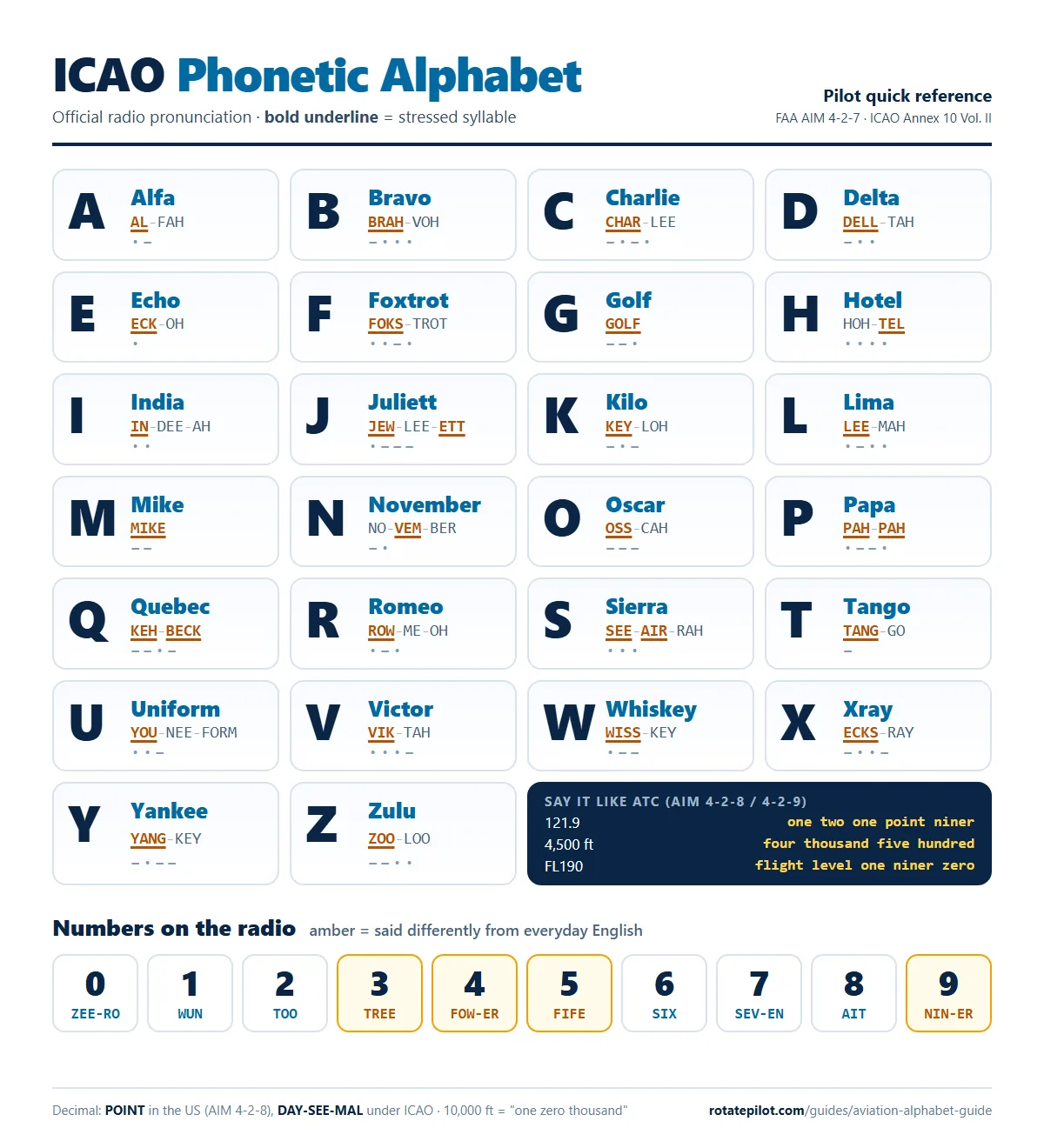
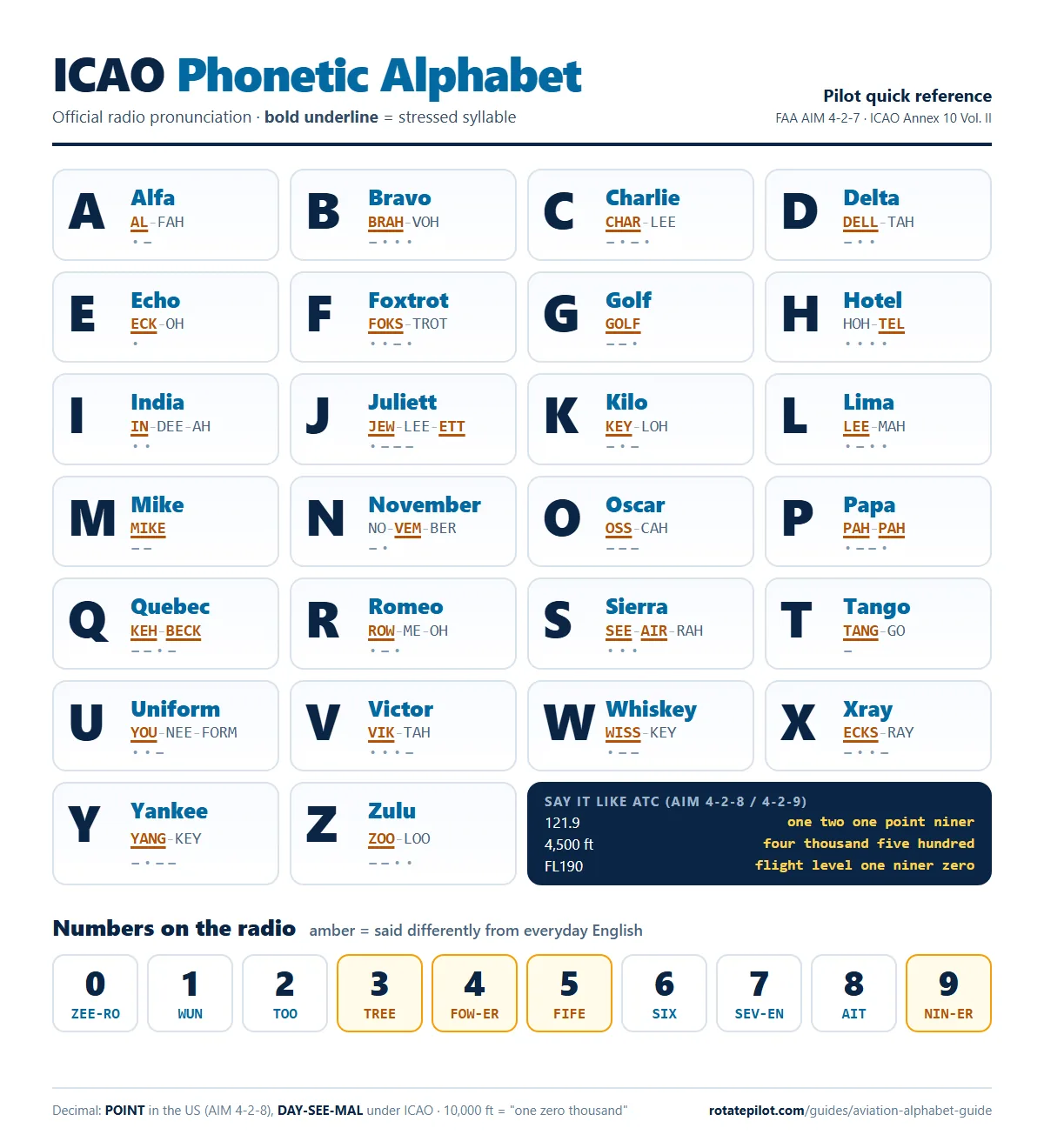
The aviation phonetic alphabet is the ICAO radiotelephony alphabet: Alfa, Bravo, Charlie, Delta, Echo, Foxtrot, Golf, Hotel, India, Juliett, Kilo, Lima, Mike, November, Oscar, Papa, Quebec, Romeo, Sierra, Tango, Uniform, Victor, Whiskey, Xray, Yankee, Zulu. Pilots also say 3 as “tree”, 5 as “fife” and 9 as “niner” (FAA AIM 4-2-7).
Official source: FAA Aeronautical Information Manual 4-2-7 and ICAO Annex 10, Volume II. Also covered here: squawk codes, ICAO vs IATA airport codes, airline callsigns and core ATC phraseology.
Learn it with flip cards
Tap a card to flip it: you get the official pronunciation with the stressed syllable highlighted, the Morse code, and a spoken example if your browser supports audio. Then spell your own tail number below the deck.
Tap a card to hear and see how it is said
November One Seven Two Sierra Papa
ICAO phonetic alphabet with pronunciation (A–Z)
The code words and pronunciations below are exactly as the FAA prints them in the Aeronautical Information Manual, TBL 4-2-7. The highlighted syllable is the one ICAO Annex 10 marks as stressed. Note the official spellings: Alfa (not Alpha), Juliett (two t's) and Xray, chosen so speakers of any language pronounce them the same way.
| Letter | Code word | Say it | Morse |
|---|---|---|---|
| A | Alfa(Alpha) | AL-FAH | ·– |
| B | Bravo | BRAH-VOH | –··· |
| C | Charlie | CHAR-LEEor SHAR-LEE | –·–· |
| D | Delta | DELL-TAH | –·· |
| E | Echo | ECK-OH | · |
| F | Foxtrot | FOKS-TROT | ··–· |
| G | Golf | GOLF | ––· |
| H | Hotel | HOH-TEL | ···· |
| I | India | IN-DEE-AH | ·· |
| J | Juliett(Juliet) | JEW-LEE-ETT | ·––– |
| K | Kilo | KEY-LOH | –·– |
| L | Lima | LEE-MAH | ·–·· |
| M | Mike | MIKE | –– |
| N | November | NO-VEM-BER | –· |
| O | Oscar | OSS-CAH | ––– |
| P | Papa | PAH-PAH | ·––· |
| Q | Quebec | KEH-BECK | ––·– |
| R | Romeo | ROW-ME-OH | ·–· |
| S | Sierra | SEE-AIR-RAH | ··· |
| T | Tango | TANG-GO | – |
| U | Uniform | YOU-NEE-FORMor OO-NEE-FORM | ··– |
| V | Victor | VIK-TAH | ···– |
| W | Whiskey | WISS-KEY | ·–– |
| X | Xray(X-ray) | ECKS-RAY | –··– |
| Y | Yankee | YANG-KEY | –·–– |
| Z | Zulu | ZOO-LOO | ––·· |
Sources: FAA Aeronautical Information Manual (AIM) 4-2-7, TBL 4-2-7; ICAO Annex 10, Volume II, Chapter 5 (5.2.1.3 spelling, stressed syllables). Checked Oct 3, 2026.
How pilots say numbers: tree, fife, niner
Four digits are said differently on the radio. 3 is “tree”, 4 is “fow-er”, 5 is “fife” and 9 is “niner”. Each change makes the digit survive a noisy, clipped transmission and keeps it from sounding like another number.
- 3 = TREEThe 'th' sound is hard for many non-native speakers and blurs on a noisy frequency.
- 4 = FOW-ERTwo clear syllables so it cannot be swallowed or confused with 'for'.
- 5 = FIFEEnds in a hard 'f' so it is not confused with 'fire' or 'nine'.
- 9 = NIN-ERAn extra syllable separates it from 'five' and from the German 'nein' (no).
- decimalICAO says DECIMAL; in the US the FAA says POINT (AIM 4-2-8) and honors DECIMAL from ICAO users.
Say it like ATC: altitudes, headings, frequencies and time
| You see | You say | Rule |
|---|---|---|
| Altitude 4,500 ft | “four thousand five hundred” | AIM 4-2-8 |
| Altitude 10,500 ft | “one zero thousand five hundred” | AIM 4-2-8 |
| Flight level 190 | “flight level one niner zero” | AIM 4-2-9 |
| Heading 090 | “heading zero niner zero” | AIM 4-2-10 |
| Frequency 121.9 | “one two one point niner” | AIM 4-2-8 (ICAO: decimal) |
| Speed 250 knots | “two five zero knots” | AIM 4-2-11 |
| Time 0920 UTC | “zero niner two zero zulu” | AIM 4-2-12 |
| Airway V12 | “Victor Twelve” | AIM 4-2-8 |
| Runway 27L | “runway two seven left” | AIM 4-2-8 |
| Altimeter 29.92 | “altimeter two niner niner two” | digit by digit |
In the US the decimal point is spoken as “point”; ICAO procedures use “decimal”, and the FAA honors it from aircraft that use ICAO procedures (AIM 4-2-8). Below 18,000 ft MSL altitudes are spoken in thousands and hundreds; at and above, as a flight level (AIM 4-2-9).
Printable phonetic alphabet chart
One page, white background, made for a kneeboard or the wall next to your desk. It carries the same official pronunciations as the table above, the stressed syllables and the radio numbers.
Could you pass the PPL written today?
Free practice test from the real FAA question bank — instant score, every answer explained, no account needed.
Practice the Phonetic Alphabet Interactively
Our free phonetic alphabet trainer has three modes: spelling practice, quiz mode, and random callsign generation. Master Alpha through Zulu in a few sessions.
Transponder Squawk Codes
Transponder codes (squawk codes) are 4-digit octal numbers (digits 0-7 only) set on the aircraft's transponder to identify the aircraft on ATC radar. Three codes are reserved for emergencies and must be memorized by every pilot. A useful mnemonic: "75 — taken alive, 76 — need a fix, 77 — going to heaven."
Indicates the aircraft has been hijacked or is under unlawful interference. ATC will confirm with discrete questioning. Do NOT squawk 7500 by accident — it triggers immediate security response.
Indicates loss of two-way radio communication. ATC will attempt contact on all frequencies, use light signals, and provide radar vectors. Pilot should follow lost-comm procedures (FAR 91.185).
General emergency. Squawk 7700 to declare an emergency of any kind — engine failure, medical emergency, fuel emergency, etc. Triggers priority handling and alerts all ATC facilities.
Default transponder code for VFR flight in the US when no specific code has been assigned. All VFR aircraft not in contact with ATC should squawk 1200.
Default VFR code used in many countries outside the US (ICAO standard). Check the country-specific AIP for local VFR squawk codes.
Used in many ICAO countries when no code has been assigned, for example when entering radar coverage from an area without it. Check the AIP of the country you fly in.
Military pilots operating VFR or IFR within restricted or warning areas set 4000 unless ATC assigns another code (AIM 4-1-20). Civil pilots never use it on their own.
VFR gliders squawk 1202 instead of 1200 (AIM 4-1-20). Firefighting aircraft not in contact with ATC may use 1255.
"Under no circumstances should a pilot of a civil aircraft operate the transponder on Code 7777. This code is reserved for military interceptor operations" (AIM 4-1-20).
Important Notes on Squawk Codes
- •Squawk codes only use digits 0 through 7 (octal). Codes like 8000 or 1298 are invalid.
- •When ATC assigns a discrete code, set it immediately and confirm: "Squawk four five two three, November One Two Three Alpha Bravo."
- •Avoid passing through 7500, 7600 or 7700 when changing codes. The AIM example: going from 2700 to 7200, switch first to 2200 and then to 7200, not to 7700 (AIM 4-1-20).
- •Mode C adds altitude reporting. Mode S adds data link capability. ADS-B Out is required in the airspace listed in 14 CFR 91.225 (Class A, B and C, the Mode C veil, and Class E at and above 10,000 ft MSL, among others).
Common Aviation Abbreviations
Aviation is full of abbreviations and acronyms. Here are the most important ones every pilot — from student to ATP — needs to know. These appear in METARs, NOTAMs, approach plates, ATC clearances, and daily flight operations.
Recorded weather and airport info broadcast on a loop. Identified by letter (e.g., "Information Alpha"). Pilots must acknowledge the current ATIS letter on initial contact.
Standardized weather observation issued every hour (or as a SPECI for significant changes). Includes wind, visibility, clouds, temperature, dewpoint, and altimeter setting.
Weather forecast for a specific airport, covering a 24-30 hour period. Uses the same format as METARs but with forecast modifiers like TEMPO, BECMG, and PROB.
Advisory notice containing information on hazards, changes, or temporary conditions at an airport or along a route. Mandatory preflight reading. Formerly "Notice to Airmen."
Ground-based radio navigation aid that transmits 360 radials. Pilots tune the frequency and select a radial to navigate TO or FROM the station. Being phased out in favor of GPS.
Low-frequency radio beacon used with an ADF (Automatic Direction Finder) receiver. Points toward the station. Oldest form of radio navigation still in limited use.
Precision approach system providing lateral (localizer) and vertical (glide slope) guidance to a runway. Categories I, II, and III define minimum visibility requirements.
Radio navigation system that measures slant-range distance between aircraft and a ground station. Often co-located with VOR or ILS. Displays distance in nautical miles.
Satellite-based navigation. WAAS-enabled GPS can provide approach capability down to 200 feet above the runway (LPV approaches). Now the primary navigation method for most GA pilots.
Navigation method allowing flight on any desired path, not limited to ground-based navaids. GPS-based RNAV is standard in modern aviation. Required for many airspace and approach procedures.
Published departure procedure that provides routing from the runway to the en-route airway system. Simplifies clearances and reduces radio congestion.
Published arrival procedure connecting the en-route airway system to an approach procedure at the destination airport. Includes altitude and speed restrictions.
Temporary airspace restriction for security (presidential movement), disasters, sporting events, or military operations. Violating a TFR can result in certificate action and interception.
Frequency used for self-announce position reports at non-towered airports. Often 122.8 or the listed frequency on the chart. All pilots in the area should monitor and broadcast.
Radio frequency at non-towered airports for airport advisory (wind, runway in use) and services (fuel, taxi). Often the same frequency as CTAF.
Weather report submitted by pilots in flight. Includes turbulence, icing, visibility, and cloud layers. Extremely valuable for other pilots and meteorologists.
Weather advisory for severe conditions: thunderstorms, severe turbulence, severe icing, volcanic ash, or tropical cyclones. Affects all aircraft.
Weather advisory for moderate conditions: moderate turbulence (Tango), moderate icing (Zulu), and IFR/mountain obscuration (Sierra). Primarily for small aircraft.
Airborne system that detects nearby transponder-equipped aircraft and issues traffic advisories (TA) and resolution advisories (RA). Mandatory on Part 121 aircraft.
GPS self-check function that verifies satellite geometry is adequate for IFR navigation. Must be predicted available for GPS approaches. Requires 5+ satellites.
Airport Identifiers: ICAO vs. IATA Codes
Every airport in the world has at least one standardized code. Pilots primarily use ICAO codes (4 letters), while passengers and airlines typically use IATA codes (3 letters). Understanding the ICAO coding system helps you identify any airport's region at a glance.
ICAO Code Structure
- K = Contiguous United States (KJFK, KLAX, KATL)
- C = Canada (CYYZ, CYVR)
- E = Northern Europe (EGLL = UK, EDDF = Germany)
- L = Southern Europe (LFPG = France, LIRF = Italy)
- R = East Asia (RJTT = Japan, RKSI = South Korea)
- V = South Asia (VHHH = Hong Kong, VIDP = India)
- O = Middle East (OMDB = Dubai, OEJN = Saudi Arabia)
- Y = Australia (YSSY, YMML)
- S = South America (SBGR = Brazil, SCEL = Chile)
- M = Central America & Mexico (MMMX = Mexico City)
IATA Code System
- 3-letter codes assigned by IATA for commercial use
- Used on boarding passes, baggage tags, and ticketing
- Often derived from the city or airport name (JFK, LAX, CDG)
- Some are historical and not intuitive (ORD = O'Hare, from old name "Orchard Field")
- Not all airports have IATA codes (small/private airports)
- Pilots rarely use IATA codes operationally
Example Airport Codes
| ICAO | IATA | Airport | Location |
|---|---|---|---|
| KJFK | JFK | John F. Kennedy International | New York, USA |
| EGLL | LHR | London Heathrow | London, UK |
| LFPG | CDG | Charles de Gaulle | Paris, France |
| RJTT | HND | Tokyo Haneda | Tokyo, Japan |
| OMDB | DXB | Dubai International | Dubai, UAE |
| KLAX | LAX | Los Angeles International | Los Angeles, USA |
| EDDF | FRA | Frankfurt Airport | Frankfurt, Germany |
| VHHH | HKG | Hong Kong International | Hong Kong |
| YSSY | SYD | Sydney Kingsford Smith | Sydney, Australia |
| SBGR | GRU | Guarulhos International | Sao Paulo, Brazil |
Explore our full airport directory with weather, runways, and frequencies. Browse all airports →
Airline Callsigns
Each airline has an ICAO three-letter designator and a telephony callsign used on the radio. The callsign is combined with the flight number for ATC communications. For example, British Airways flight 117 is "Speedbird One One Seven" — not "British Airways 117." Some callsigns are famous and have historical origins.
| Airline | ICAO Code | Callsign |
|---|---|---|
| American Airlines | AAL | American |
| Delta Air Lines | DAL | Delta |
| United Airlines | UAL | United |
| Southwest Airlines | SWA | Southwest |
| JetBlue Airways | JBU | JetBlue |
| Alaska Airlines | ASA | Alaska |
| Spirit Airlines | NKS | Spirit Wings |
| FedEx Express | FDX | FedEx |
| UPS Airlines | UPS | UPS |
| British Airways | BAW | Speedbird |
| Lufthansa | DLH | Lufthansa |
| Air France | AFR | Air France |
| KLM Royal Dutch | KLM | KLM |
| Emirates | UAE | Emirates |
| Qantas | QFA | Qantas |
| Ryanair | RYR | Ryanair |
| Singapore Airlines | SIA | Singapore |
| Cathay Pacific | CPA | Cathay |
| Air Canada | ACA | Air Canada |
| Turkish Airlines | THY | Turkish |
General Aviation Callsigns
Non-airline aircraft use their registration number as their callsign. In the US, this starts with "N" (the US nationality prefix). After initial contact, ATC may abbreviate to the last three characters.
- Full:"Cessna November One Two Three Alpha Bravo"
- Abbreviated:"Cessna Three Alpha Bravo"
- Type + Full:"Bonanza November Four Five Six Charlie Delta"
- Helicopter:"Helicopter November Seven Eight Niner Golf Hotel"
ATC Phraseology Basics
Standard ATC phraseology ensures clear, concise, and unambiguous communication between pilots and controllers. Every word has a precise meaning — using the wrong word can cause misunderstanding. Here are the essential phrases every pilot must know, along with their exact meanings and common usage notes.
Does NOT mean "yes" or "affirmative." It only means the message was received.
Short for "will comply." Stronger than Roger — implies action.
Use instead of "yes" on the radio. ICAO standard uses "Affirm."
Clear and unambiguous. Never say "no" on the radio — use "Negative."
Never say "repeat" — in military communications, "repeat" means fire again.
ATC uses this to verify you received a clearance correctly. Readback is mandatory for runway assignments, altitudes, and headings.
Example: "Squawk 4523" means set transponder to 4523. "Squawk ident" means press the IDENT button.
"Cleared for takeoff," "Cleared to land," "Cleared ILS Runway 27." This is an authorization, not a suggestion.
"Hold short Runway 28L" — stop before the hold short line. Requires mandatory readback.
Formerly "position and hold" in the US. You are ON the runway but NOT cleared for takeoff.
Mandatory instruction. Apply full power, pitch up, follow published missed approach or ATC instructions.
Pilots can always say "unable" for safety. Example: "Unable maintain 250 knots, minimum clean speed 270."
Said three times: "Pan-Pan, Pan-Pan, Pan-Pan." Examples: fuel concern, sick passenger, minor system failure.
Said three times: "Mayday, Mayday, Mayday." Highest priority. Engine failure, fire, structural failure.
Creates a highlighted return on the controller's radar scope for positive identification.
"Maintain 6,000" means fly at 6,000 feet. "Maintain 250 knots" means hold that speed.
"Contact approach on 124.8" means switch to that frequency and check in.
Different from "contact." Just listen — they will call you when ready.
Sample Radio Exchange
VFR departure from a towered airport — Cessna N123AB departing Runway 28L
Pilot: "Oakland Ground, Cessna One Two Three Alpha Bravo, at Transient Parking with Information Golf, VFR northbound, request taxi."
Ground: "Cessna Three Alpha Bravo, Oakland Ground, taxi Runway Two Eight Left via Alpha, Bravo."
Pilot: "Taxi Runway Two Eight Left via Alpha, Bravo, Cessna Three Alpha Bravo."
Tower: "Cessna Three Alpha Bravo, Runway Two Eight Left, cleared for takeoff, left turn approved."
Pilot: "Cleared for takeoff Runway Two Eight Left, left turn approved, Cessna Three Alpha Bravo."
Practice realistic ATC scenarios with our interactive tool. Try ATC Practice →
Mandatory Readback Items
Not every ATC instruction requires a verbatim readback, but certain safety-critical items must be read back to confirm correct receipt. Failing to read back these items is a common student pilot error — and can lead to runway incursions or altitude deviations.
| Item | Example ATC Instruction | Correct Readback |
|---|---|---|
| Runway Assignment | "Runway Two Eight Left, cleared for takeoff" | "Cleared for takeoff Runway Two Eight Left, Three Alpha Bravo" |
| Hold Short | "Hold short Runway Two Eight Left" | "Hold short Runway Two Eight Left, Three Alpha Bravo" |
| Altitude Assignment | "Climb and maintain six thousand" | "Climb and maintain six thousand, Three Alpha Bravo" |
| Heading Assignment | "Turn right heading zero niner zero" | "Right heading zero niner zero, Three Alpha Bravo" |
| Altimeter Setting | "Altimeter two niner niner two" | "Two niner niner two, Three Alpha Bravo" |
| Transponder Code | "Squawk four five two three" | "Squawk four five two three, Three Alpha Bravo" |
| Frequency Change | "Contact approach on one two four point eight" | "One two four point eight, Three Alpha Bravo" |
| Clearance Limit | "Cleared to KJFK via..." | Full readback of entire clearance |
Always end your readback with your callsign so ATC can confirm it was the right aircraft. If ATC says nothing after your readback, it was correct. If you made an error, they will correct you.
Common Radio Communication Mistakes
Even experienced pilots occasionally make radio errors. Knowing the most common mistakes helps you avoid them. Here are the errors flight instructors see most frequently — and how to fix them.
Saying "Roger" when you mean "Wilco"
Why it matters: Roger only means "received." If ATC tells you to do something and you reply "Roger," you have not confirmed you will comply. Use "Wilco" (will comply) or read back the instruction.
Fix: Rule: If it is an instruction (climb, descend, turn, hold short), read it back or say Wilco. If it is just information (traffic advisory, weather update), Roger is fine.
Saying "repeat" instead of "say again"
Why it matters: In military communications, "repeat" means "fire again" (as in artillery). While this is less critical in civil aviation, the standard phraseology is "say again" to avoid any ambiguity.
Fix: Always use "say again" to request a repeat of the last transmission. It is correct, professional, and unambiguous.
Blocking the frequency with long transmissions
Why it matters: Holding the push-to-talk button while thinking of what to say blocks the entire frequency. Other aircraft cannot transmit emergencies or position reports while you are keyed up.
Fix: Plan what you will say BEFORE pressing the PTT button. Keep transmissions brief: who you are, where you are, what you want. Release the button between thoughts if needed.
Not using your callsign
Why it matters: Starting a transmission without your callsign ("Tower, requesting runway change") forces ATC to ask who is calling. At busy airports, this wastes time and causes confusion.
Fix: Always include your callsign in every transmission: "Tower, Cessna Three Alpha Bravo, request runway change to Two Eight Right."
Pronouncing 9 as "nine" instead of "niner"
Why it matters: "Nine" can sound like "nein" (German for no) or "five" in poor radio conditions. "Niner" is unambiguous in all conditions and languages.
Fix: Always use the ICAO pronunciations: tree (3), fife (5), niner (9). These exist for a reason — they have been tested across dozens of languages and accent types.
Not monitoring the frequency before transmitting
Why it matters: Stepping on (transmitting over) another pilot or controller is unprofessional and potentially dangerous. It blocks both transmissions.
Fix: Listen for at least 5-10 seconds before your first transmission on any new frequency. Ensure the frequency is clear before pressing PTT.
Using non-standard phraseology
Why it matters: Casual language ("We're going to head on over to runway 28") is ambiguous and unprofessional. Standard phraseology exists because each phrase has been tested for clarity.
Fix: Study and use the standard phrases: "Taxi to Runway Two Eight" not "head over to 28." "Cleared to land" not "OK to land." Precision in language equals precision in flying.
History of the Aviation Phonetic Alphabet
The phonetic alphabet used in aviation today was not the first attempt at a spelling alphabet. Several systems preceded it, and the path to the current NATO/ICAO standard involved decades of development and testing across multiple countries and languages.
Early Spelling Alphabets
The first radio spelling alphabets emerged with early aviation and telecommunications. The Royal Navy, the US military, and various telegraph services each developed their own systems. There was no international standard — a British pilot and an American pilot might use completely different words for the same letter.
ITU Radio Alphabet
The International Telecommunication Union (ITU) adopted the first international spelling alphabet: Amsterdam, Baltimore, Casablanca, etc. This was used primarily in maritime and telegraphy. It was city-based and proved difficult for non-English speakers to pronounce consistently.
Joint Army/Navy Phonetic Alphabet
During World War II, the US and UK forces adopted the "Able Baker" alphabet: Able, Baker, Charlie, Dog, Easy, Fox, George... This worked well for English speakers but was problematic for the growing number of international military operations involving non-English-speaking allies.
ICAO Development Phase
ICAO recognized the need for a truly international alphabet. Professor Jean-Paul Vinay of the Universite de Montreal led a linguistics study that tested hundreds of word combinations across 31 countries. Words were evaluated for recognizability in English, French, Spanish, and Portuguese — the four ICAO languages at the time.
Current Alphabet Adopted
After extensive field testing, ICAO's revised alphabet took effect on March 1, 1956, and NATO adopted the same words. The key requirement: each word must be immediately recognizable to speakers of the major world languages and must remain clear over poor-quality radio connections. This alphabet has remained unchanged since 1956 — over 65 years of continuous use.
Universal Standard
The NATO/ICAO phonetic alphabet is now used by virtually every aviation authority, military force, maritime service, emergency service, and telecommunications organization worldwide. It is taught in every flight school, military academy, and maritime training program. Its longevity is a testament to how well the original linguistic research was conducted.
Beyond Aviation: Where Else the Phonetic Alphabet Is Used
While pilots are the most visible users of the NATO phonetic alphabet, it is essential in many other fields. Understanding these broader applications helps reinforce why the system is so deeply ingrained in professional communication.
Military Operations
All branches of every NATO military use this alphabet for all radio and written communication. Grid coordinates, unit designations, and operation names all use phonetic spelling. "Alpha Company" and "Bravo Team" are direct references to the alphabet.
Maritime / Shipping
Required by the International Maritime Organization (IMO) for all ship-to-shore and ship-to-ship communications. Vessel names, port designations, and cargo codes are all spelled phonetically when clarity is needed.
Emergency Services
Police, fire departments, and EMS use the phonetic alphabet for license plates, addresses, suspect descriptions, and radio communications. "Suspect vehicle, license plate: Alpha, Seven, Bravo, Three, Delta, Niner."
Telecommunications & IT
Customer service, technical support, and IT professionals use it to spell serial numbers, reference codes, passwords, and email addresses over the phone. "Your confirmation code is: Tango, Seven, Foxtrot, Niner, Kilo."
Amateur (Ham) Radio
Licensed amateur radio operators use the NATO alphabet for callsign identification, especially during contests, emergency communications (ARES/RACES), and DX (long-distance) contacts where signal quality may be poor.
International Diplomacy
The United Nations and international organizations use the phonetic alphabet in peacekeeping operations, humanitarian coordination, and any situation requiring clear multi-lingual communication.
Practice Tips & Resources
Knowing the phonetic alphabet and ATC phraseology is one thing — using them fluently under pressure is another. Here are proven strategies to build confidence and speed.
Spell Everything You See
License plates, street signs, product labels. Spell them phonetically in your head (or out loud) as you encounter them. This is the single fastest way to internalize the alphabet. Within 3-4 days, it becomes automatic.
Listen to LiveATC
LiveATC.net streams real ATC communications from airports worldwide. Listen to your local airport's tower and approach frequencies. You'll hear real pilots using the phonetic alphabet, standard phraseology, and number pronunciation in context.
Practice with a Partner
Have someone give you random letter/number sequences and spell them back phonetically. Simulate clearances: "Cleared to KORD via BRAVE2 departure, BRAVE transition, then as filed. Climb and maintain five thousand, expect flight level three five zero within ten minutes."
Use Our Interactive Trainer
The Rotate phonetic alphabet trainer (/tools/phonetic-alphabet) has three modes: spelling practice (spell words phonetically), quiz mode (hear a word, identify the letter), and callsign generator (practice realistic callsigns). Fastest path to mastery.
Pre-Write Your Clearances
Before calling ATC, write down what you want to say. Have your callsign, position, altitude, request, and ATIS information ready. Pre-planning eliminates hesitation and makes you sound professional from day one.
Chair-Fly Radio Calls
Sit in your chair and practice a full flight's radio calls from engine start to shutdown. Taxi clearance, takeoff, departure, en route, approach, landing. Say everything out loud. This builds muscle memory for the actual cockpit.
Ready to Ace Your Pilot Exam?
Phonetic alphabet, squawk codes, ATC phraseology, and hundreds more topics covered in our question bank. Practice tests, flashcards, and progress tracking for PPL, Instrument, Commercial, Part 107, and EASA ATPL.
Start for $7.49 →50% off first month with code PILOT50. Cancel anytime.
Frequently Asked Questions
How do you pronounce the NATO phonetic alphabet correctly?
Use the official FAA/ICAO pronunciation: AL-fah, BRAH-voh, CHAR-lee (or SHAR-lee), DELL-tah, ECK-oh, FOKS-trot, GOLF, hoh-TELL, IN-dee-ah, JEW-lee-ETT, KEY-loh, LEE-mah, MIKE, no-VEM-ber, OSS-cah, pah-PAH, keh-BECK, ROW-me-oh, see-AIR-rah, TANG-go, YOU-nee-form, VIK-tah, WISS-key, ECKS-ray, YANG-key, ZOO-loo. The letters come from FAA AIM TBL 4-2-7; the stressed syllables from ICAO Annex 10, Volume II.
Is it Alpha or Alfa, Juliet or Juliett?
Officially Alfa and Juliett. ICAO chose those spellings so that speakers of every language pronounce them the same way, and the FAA uses them in AIM TBL 4-2-7. Alpha and Juliet are common spellings in everyday and military use and are said the same way on the radio.
How do pilots say radio frequencies like 121.9?
Digit by digit, with the decimal said as "point" in the US: 121.9 is "one two one point niner" (AIM 4-2-8). ICAO procedures say "decimal" instead, and the FAA honors that from aircraft using ICAO procedures. Eight-point-three-three kHz channels such as 118.505 are read with all their digits.
Why do pilots use the NATO phonetic alphabet?
Pilots use the NATO phonetic alphabet (also called the ICAO phonetic alphabet) to eliminate ambiguity in radio communications. Letters like B, D, E, G, P, T, and V sound very similar over radio static and engine noise. Saying "Bravo" instead of "B" or "Tango" instead of "T" ensures the listener receives the correct letter every time. This is critical when communicating callsigns, taxiway designations, runway identifiers, and clearances where a single misheard letter could cause a dangerous situation.
What is the difference between NATO and ICAO phonetic alphabets?
They are essentially the same alphabet. The NATO phonetic alphabet and the ICAO (International Civil Aviation Organization) phonetic alphabet use identical words: Alpha through Zulu. NATO adopted the ICAO alphabet in 1956, and it has been the international standard ever since. ICAO first adopted it in 1951 and the revised version took effect on March 1, 1956. The official spellings are "Alfa" (not Alpha, because "ph" is not read as "f" in every language), "Juliett" (two t's, so French speakers do not drop the final t) and "Xray". The FAA prints exactly these spellings in AIM TBL 4-2-7.
How do pilots pronounce numbers in aviation?
ICAO specifies non-standard pronunciations for several numbers to prevent confusion. The most notable are: 3 is pronounced "tree" (not "three"), 5 is "fife" (not "five"), and 9 is "niner" (not "nine"). This prevents confusion between "three" and "free," between "five" and "fire," and between "nine" and "nein" (German for "no"). Four is also said "fow-er" (FAA AIM TBL 4-2-7). Below 18,000 ft altitudes are said in thousands and hundreds (4,500 is "four thousand five hundred"); from 10,000 ft the thousands are split into digits (10,500 is "one zero thousand five hundred", AIM 4-2-8). Headings use three digits: heading 090 is "heading zero niner zero" (AIM 4-2-10).
What does squawking 7700 mean?
Squawking 7700 means the pilot has declared a general emergency. When a pilot sets their transponder to code 7700, it triggers an alert on all ATC radar screens within range, highlighting the aircraft for immediate priority handling. The three emergency squawk codes are 7500 (hijack), 7600 (communication failure), and 7700 (emergency). A common mnemonic is: "75 — taken alive, 76 — need a fix, 77 — going to heaven." If you accidentally squawk 7700, ATC will query you. If you intentionally squawk it, expect priority handling, crash/fire/rescue standby, and possible escort by other aircraft.
What is the difference between ICAO and IATA airport codes?
ICAO codes are 4-letter codes used by pilots, ATC, and in flight plans (e.g., KJFK, EGLL, LFPG). The first letter or two indicate the region: K = contiguous US, C = Canada, EG = UK, LF = France, etc. IATA codes are 3-letter codes used by airlines and passengers for ticketing and baggage (e.g., JFK, LHR, CDG). Pilots use ICAO codes in the cockpit and on all official aviation documents. Passengers typically only see IATA codes on boarding passes and airport signage. Some small airports have ICAO codes but no IATA code.
What does "Roger" mean in aviation?
"Roger" in aviation means "I have received and understood your message." It does NOT mean "yes," "I agree," or "I will comply." If ATC gives you an instruction and you say "Roger," you are only acknowledging receipt — not confirming that you will follow the instruction. To confirm you will comply, use "Wilco" (short for "will comply"). To confirm yes, use "Affirm" or "Affirmative." The word comes from the old phonetic alphabet where "R" was represented by "Roger," standing for "received."
How do I learn the phonetic alphabet quickly?
The fastest way to learn the phonetic alphabet is through active practice, not memorization. Start by spelling your name, street address, and car license plate using the phonetic alphabet. Then move to spelling random words you see throughout the day (street signs, product labels). Within 2-3 days of active practice, you will have the entire alphabet memorized. For structured practice, use an interactive trainer like Rotate's phonetic alphabet tool (/tools/phonetic-alphabet) which has three modes: spelling practice, quiz mode, and random callsign generation. Most student pilots have it fully memorized within a week of regular practice.
What is an airline callsign and how does it work?
An airline callsign is the spoken identifier used on the radio, combined with the flight number. It consists of the airline's ICAO telephony designator (a word) plus the flight number. For example, Delta flight 1492 is called "Delta One Four Niner Two" on the radio. Some callsigns differ from the airline name: British Airways uses "Speedbird," Spirit Airlines uses "Spirit Wings," and Cargolux uses "Cargolux." General aviation aircraft use their registration number (e.g., "Cessna November One Two Three Alpha Bravo"). The callsign system prevents confusion between similar-sounding airline names.
What is the difference between Mayday and Pan-Pan?
Mayday indicates distress — the aircraft or persons aboard are in grave and imminent danger and require immediate assistance. Examples: engine failure, fire, structural failure, ditching. Pan-Pan indicates urgency — a situation that requires priority handling but is not immediately life-threatening. Examples: partial system failure, fuel concern, sick passenger, lost/uncertain of position. Both are spoken three times ("Mayday, Mayday, Mayday" or "Pan-Pan, Pan-Pan, Pan-Pan"). Mayday has absolute priority over all other communications. Pan-Pan has priority over routine traffic. In practice, if you are unsure which to use, declare Mayday — it is always better to over-declare than under-declare.
What does ATIS mean and how do pilots use it?
ATIS stands for Automatic Terminal Information Service. It is a continuous broadcast of recorded weather and airport information at towered airports. Each update is assigned a letter identifier using the phonetic alphabet (Information Alpha, Information Bravo, etc.). Before contacting ATC, pilots listen to the ATIS frequency to get current wind, visibility, ceiling, temperature, altimeter setting, active runways, and any NOTAMs or special procedures. On initial contact, pilots tell ATC which ATIS letter they have: "Approach, Cessna 12345, with Information Golf." This confirms the pilot has current information without ATC having to repeat it.
What VFR squawk code should I use?
In the United States, the standard VFR squawk code is 1200. All VFR aircraft not receiving ATC radar services should squawk 1200. In many other ICAO countries, the standard VFR code is 1000. Some countries use 7000 (e.g., UK, parts of Europe). Always check the country-specific Aeronautical Information Publication (AIP) when flying internationally. If ATC assigns you a discrete squawk code (e.g., 4523), use that code instead. When leaving ATC services, they will typically instruct you to "squawk VFR" — meaning switch back to 1200 (or your country's equivalent).
What are the most important ATC phrases for student pilots?
The essential ATC phrases every student pilot must know are: "Roger" (message received), "Wilco" (will comply), "Affirm" / "Negative" (yes/no), "Say Again" (repeat), "Unable" (cannot comply), "Hold Short" (stop before a point), "Cleared" (authorized), and "Read Back" (repeat the clearance). For safety, always read back runway assignments, altitudes, headings, and hold short instructions. If you are ever confused, say "Say Again" — controllers are used to it and prefer you ask rather than guess. Student pilots should also know: "Student Pilot" — telling ATC you are a student pilot on initial contact will get you extra patience and simpler instructions.
Related Resources
Phonetic Alphabet Trainer
Interactive 3-mode practice tool
ATC Practice Scenarios
30 realistic ATC communication drills
VOR Simulator
Interactive CDI/OBS navigation trainer
Airport Directory
ICAO codes, weather, frequencies
Free Practice Test
Test your aviation knowledge
Sectional Chart Guide
Learn to read aviation charts
Master Aviation Communications
The phonetic alphabet is just the beginning. Rotate covers everything from weather theory to regulations, with 1,900+ practice questions and detailed explanations.
Get Full Access for $7.49/mo →