Mooney M20: specs, V-speeds by serial and costs
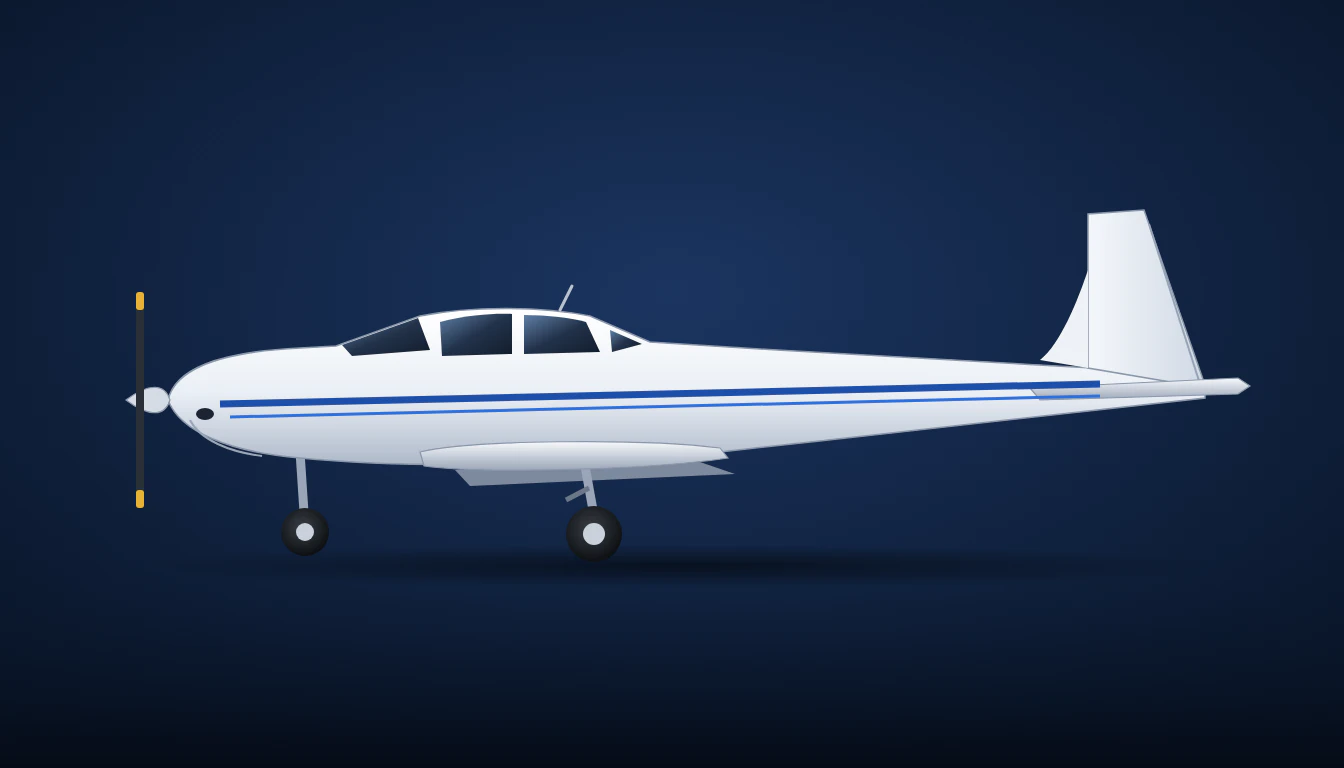
The Mooney M20 is a four-seat, low-wing single with retractable gear and a constant-speed propeller, built in many versions since 1955. The popular 200-hp M20J carries 64 usable gallons and, depending on serial number, has a Vne of 174 or 195 KIAS; the 280-hp M20R Ovation carries 89. Rentals run about $220 an hour.

Could you pass the PPL written today?
Free practice test from the real FAA question bank — instant score, every answer explained, no account needed.
Buyer and owner next step
Building a Mooney cockpit kit before a checkout or pre-buy?
We split the practical owner gear checklist into its own page: portable CO awareness, ADS-B backup, EFB mount fit, IFR note flow, fuel testing, ownership records, and what not to buy on Amazon.
Open the Mooney cockpit kitMooney cross-country cockpit kit
Three upgrades Mooney owners actually feel on long legs
The M20 rewards prepared pilots: protect your hearing, keep an independent traffic/weather backup, and mount your EFB where it stays usable in turbulence.
EFB gear to IFR judgment
ADS-B, iPad, and EFB setup give you data. IFR prep teaches what to do with it.
Pair cockpit weather tools with METAR, TAF, NOTAM, alternate, and approach-decision drills while the EFB context is fresh.
Mooney M20 specifications
The M20 is one type certificate (FAA 2A3, first issued in 1955) covering many different airplanes, so the table names the model on every row. The M20J "201" is the most common in rental and club fleets; the M20R Ovation is the 280-hp, IO-550 version.
| M20J ("201") | |
|---|---|
| Engine | Lycoming IO-360-A1B6D, -A3B6D or -A3B6, 200 hp[TCDS] |
| Seats | 4[TCDS] |
| Max weight | 2,740 lb, or 2,900 lb[TCDS, POH]2,900 lb from serial 24-3201 and 24-3218 on, or earlier airplanes modified per Mooney drawing 940071. |
| Usable fuel | 64 gal[TCDS, POH]The TCDS states the unusable fuel is not included in the 64. |
| Baggage | 120 lb[POH] |
| Landing gear | Electric retractable tricycle gear[POH]Plus a constant-speed propeller: a complex airplane under 14 CFR 61.31(e). |
| Best rate of climb (Vy) | 88 KIAS at sea level[POH]Decreasing to 80 KIAS at 10,000 ft (POH, Section 4). |
| M20R Ovation | |
| Engine | Continental IO-550-G, 280 hp at 2,500 rpm[EASA]More than 200 hp: also a high-performance airplane (61.31(f)). |
| Wingspan | 36 ft 1 in[EASA] |
| Length | 26 ft 9 in[EASA] |
| Height | 8 ft 4 in[EASA] |
| Max weight | 3,368 lb (landing 3,200 lb)[EASA] |
| Fuel | 95 gal total, 89 gal usable[EASA] |
| Max operating altitude | 20,000 ft[EASA] |
Sources
- [TCDS] FAA Type Certificate Data Sheet 2A3, Rev. 52 (2010): M20C and M20J
- [EASA] EASA Type Certificate Data Sheet IM.A.266, Issue 02 (2022): M20R Ovation
- [POH] Mooney M20J Pilot's Operating Handbook (2,900 lb airplanes), Sections 1, 2 and 4
Mooney V-speeds by model and serial number
No other airplane in these guides changes its limits as much with the serial number. An early M20J and a late one differ by 21 knots of Vne.
| KIAS unless noted | M20J (S/N 24-0171+) | M20J (early) | M20R (to 29-0494) | M20C (S/N 690001+) |
|---|---|---|---|---|
| Engine | 200 hp | 200 hp | 280 hp | 180 hp |
| Max weight (lb) | 2,740 / 2,900 | 2,740 | 3,368 | 2,575 |
| Va | 118 | 118 | 127 | 115 |
| Vfe (full flaps) | 110 | 110 | 110 | 109 |
| Vno | 174 | 152 | 174 | 152 |
| Vne | 195 | 174 | 195 | 174 |
| Gear extended (Vle) | 132 or 162 | 104 | 165 | 104 |
| Usable fuel (gal) | 64 | 64 | 89 | 52 |
Sources
- [TCDS] FAA Type Certificate Data Sheet 2A3, Rev. 52 (2010): M20C and M20J
- [EASA] EASA Type Certificate Data Sheet IM.A.266, Issue 02 (2022): M20R Ovation
From FAA TCDS 2A3 (M20C, M20J) and EASA TCDS IM.A.266 (M20R; from S/N 29-0495 Vne is 194, Vno 173 and Vle 164). Mooney speed limits change with the serial number and with service bulletins (for example SB M20-198 raises an early M20J's Vne to 195), so read them from the POH and placards of the specific airplane. Gear operating speeds vary the same way.
Complex or high-performance?
Complex: every M20
Retractable gear, flaps and a constant-speed propeller make any Mooney a complex airplane: you need the one-time endorsement in 14 CFR 61.31(e).
High-performance: above 200 hp
The 200-hp M20J is not high-performance; the 280-hp M20R Ovation is, and needs the 61.31(f) endorsement too.
Most Mooney owners fly IFR. The instrument rating exam prep covers the written; the G1000 guide explains the glass panel in later Mooneys.
How much it costs to rent a Mooney
Mooneys are rare on rental lines: only three of the 30 rate sheets we read on October 3, 2026 listed one.
| Mooney M20J / M20F | $220/hr medianRange $175-$230 wet, only 3 operators publish a Mooney rate. |
|---|---|
| Beechcraft Bonanza (for comparison) | $217/hr medianRange $170-$316, 4 operators. |
| Cirrus SR22 (for comparison) | $507.50/hr medianRange $361-$647, 6 operators. |
Aircraft only, US dollars per flight hour, from published rate sheets read October 3, 2026. “Wet” means the sheet says fuel is included. Some clubs bill tach time (10-15% fewer hours than Hobbs) and add monthly dues. Instructor time is billed on top: $50-$125 per hour on the same rate sheets, about $80 typical.
Schools and clubs in the sample
- Aces High Aviation (Long Beach, CA)
- CP Aviation (Santa Paula, CA)
- EFI Flight School (Murrieta, CA)
- Fly Goodyear (Goodyear, AZ)
- Mountain Peaks Aviation (Ogden, UT)
- Pilot Rise (Dallas-Fort Worth, TX)
- The Flight School Inc. (Spring, TX)
- Texas Flight Aviation (Spring, TX)
- Metro Flyers Club (Denton, TX)
- St. Charles Flying Service (St. Charles, MO)
- St. Pete Air (St. Petersburg, FL)
- Rexair (Naples, FL)
- All2fly (Georgia)
- MacAir (Fort Knox, KY)
- Doylestown Airport (Doylestown, PA)
- Moore Aviation (Beaver Falls, PA)
- East Hill Flying Club (Ithaca, NY)
- Jersey Aero Club (Lakewood, NJ)
- TSS Flying Club (Washington, DC area)
- Prescott Flying Club (South St. Paul, MN)
- Skyhawk Flying Club (Omaha, NE)
- Bergstrom Aircraft (Pasco, WA)
- Eastern Cincinnati Aviation (Batavia, OH)
- Capital City Aviation (Columbus, OH)
- Fly Synergy (Illinois)
- Performance Flight (Westchester, NY)
- American Flight Schools (Colorado and California)
- Hoosier Aviation (Terre Haute, IN)
Mooney M20 variants
| Model | Notes |
|---|---|
| M20 / M20A | The 1955 original type certificate; early airplanes had wooden wings. |
| M20C Ranger | Lycoming O-360-A1D, 180 hp, 2,575 lb (TCDS 2A3). |
| M20E / M20F | Fuel-injected 200-hp versions that preceded the M20J. |
| M20J ("201") | IO-360, 200 hp, type certificated September 1976; about 1,700 built (secondary source). |
| M20K / M20M | Turbocharged versions (231/252, Bravo). |
| M20R Ovation | Continental IO-550-G, 280 hp, 3,368 lb (EASA TCDS). |
| M20TN / M20V Acclaim | Turbocharged Acclaim versions. |
Common issues to check
Gear system rigging
The Mooney gear uses rubber shock discs and a retraction mechanism that needs correct rigging and inspection; check the gear history in the logbooks.
Wet-wing fuel tank sealant
The fuel tanks are sealed areas of the wing structure, so seeping sealant is a known maintenance item on older airframes.
Steel tube cage corrosion
The cabin is built around a steel tube structure; inspect for rust, especially on airplanes kept outside.
Serial-number-specific limits
Vne, Vno, gear speeds and max weight change with serial number and service bulletins. Read them off the POH and placards of the airplane you fly.
Check airworthiness directives against the FAA database for the exact serial number, and use a shop that knows Mooneys for the pre-buy.
Gear for the Mooney M20
The kit that actually rides along in a Mooney M20 — picked from what trainers and owners already use.
Mooney M20 FAQ
What are the Mooney M20J V-speeds?
From FAA TCDS 2A3: Va 118 KIAS, Vfe 110 KIAS with full flaps, and, for serial 24-0171 and on (or earlier airplanes with SB M20-198), Vno 174 and Vne 195 KIAS. Earlier M20Js have Vno 152 and Vne 174. The 2,900-lb M20J POH gives Vy 88 KIAS at sea level, decreasing to 80 at 10,000 ft. Gear speeds also depend on the serial number.
Is a Mooney a complex or high-performance airplane?
Every M20 has retractable gear and a constant-speed propeller, so it needs a complex endorsement (14 CFR 61.31(e)). A high-performance endorsement (61.31(f)) is needed only above 200 hp: the 280-hp M20R Ovation needs one, the 200-hp M20J does not.
How much fuel does a Mooney M20J hold?
64 US gallons usable, according to both the TCDS and the POH; the unusable fuel is on top of that figure. The M20R Ovation holds 95 gallons, 89 usable, and an M20C from serial 2623 holds 52.
How much does it cost to rent a Mooney?
Few schools rent them. The three published rates we found on October 3, 2026 were $175 to $230 an hour wet (median $220) for M20J and M20F airplanes, and clubs usually require a checkout and minimum experience first.
Why does the Mooney tail look backwards?
In level flight the fin's leading edge is close to vertical while the rudder's trailing edge leans forward, so the tail looks swept forward. It is the Mooney's visual signature rather than a performance secret.
Mooney vs Bonanza vs Cirrus: which is faster?
It depends on the models: compare cruise numbers from each airplane's POH at the same power setting and altitude. What the documents do show is the size difference: an M20J weighs up to 2,740-2,900 lb with 200 hp, a G36 Bonanza 3,650 lb with 300 hp and an SR22 3,600 lb with 310 hp.
How many Mooney M20s were built?
More than 11,000 M20s of all versions according to secondary sources, including about 1,700 M20Js. Mooney stopped production in 2019.
Compare the aircraft guides
Same format in every guide: spec tables with their sources, V-speeds from the POH and rental costs measured on real rate sheets.
Cessna 152
2 seats · high wing · fixed gear · 110 hp
Cessna 172 Skyhawk
4 seats · high wing · fixed gear · 180 hp (172S)
Piper PA-28 Cherokee
4 seats · low wing · fixed gear · 140-180 hp
Cessna 182 Skylane
4 seats · high wing · fixed gear · 230 hp (182T)
Mooney M20 You are here
4 seats · low wing · retractable gear
Cirrus SR22
Low wing · fixed gear · 310 hp · airframe parachute (CAPS)
Beechcraft Bonanza
6 seats (G36) · low wing · retractable gear · 300 hp
Garmin G1000
Glass cockpit: PFD, MFD and the knobs that run them
Pursuing high-performance flying?
Most Mooney owners also pursue instrument and commercial ratings. Rotate covers all five FAA written exams.