Beechcraft Bonanza Complete Guide V-Tail, G36, Specs & Costs (2026)
By Renzo, CPL · Updated March 2026
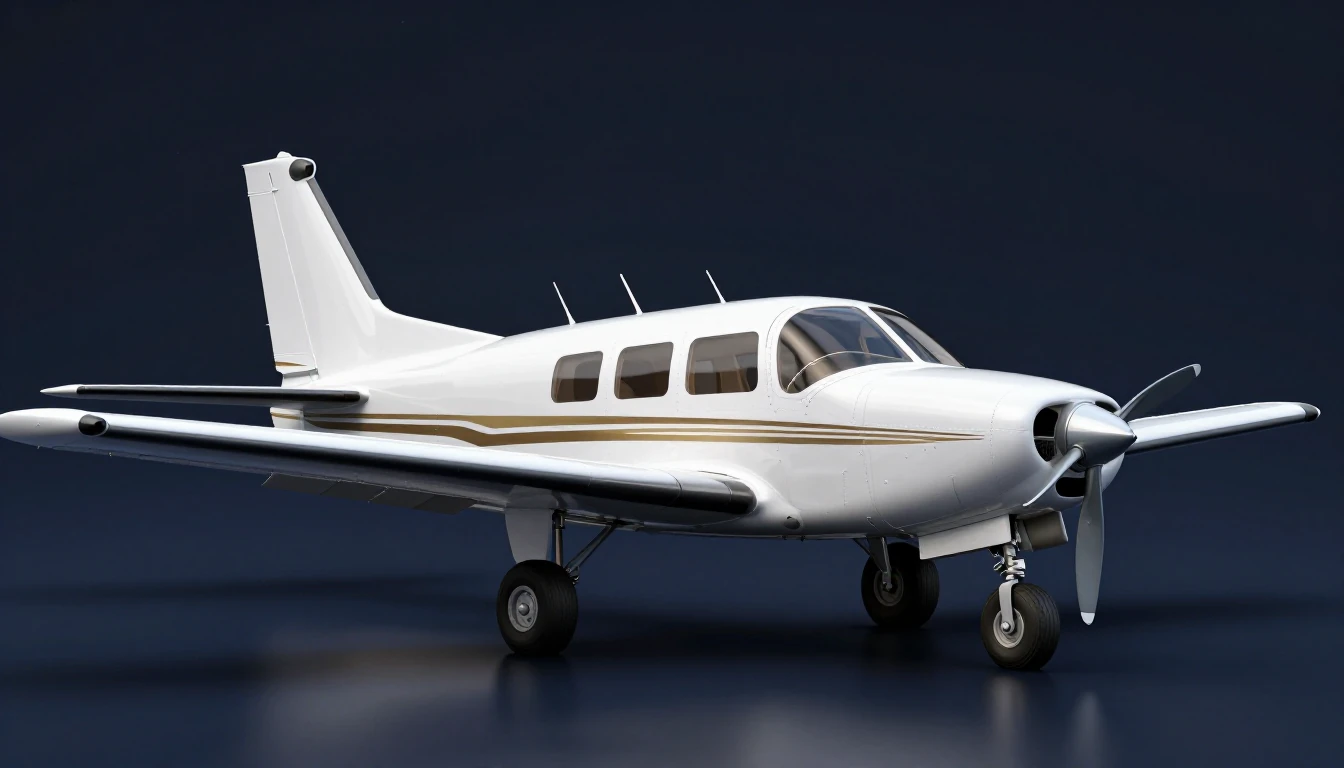
The Beechcraft Bonanza is one of the most iconic aircraft in general aviation history. First produced in 1947, it holds the record as the longest continuously produced aircraft in the world. From the distinctive V-tail Model 35 to the current-production G36 with its Garmin G1000 NXi glass cockpit, the Bonanza has been the aspirational single-engine aircraft for pilots seeking speed, capability, and prestige. This guide covers every model, variant, specification, cost, and operational consideration you need to know.
1. History & Legacy
The Beechcraft Model 35 Bonanza first flew on December 22, 1945, and entered production in 1947. Designed by Walter Beech and engineer Ralph Harmon, it was a revolutionary aircraft for its era: all-metal construction, retractable tricycle landing gear, and the now-iconic V-tail that gave it a distinctive silhouette unlike anything else in the sky. At a time when most light aircraft still used tube-and-fabric construction with conventional tailwheels, the Bonanza was a bold leap forward.
The original Model 35 was powered by a 185-horsepower Continental E-185 engine and could cruise at 160 mph -- staggeringly fast for a 1947 personal aircraft. Its sleek design, comfort, and performance immediately attracted well-heeled buyers, establishing the Bonanza as the premium single-engine aircraft in the general aviation market, a position it has held for nearly eight decades.
Over its production history, the Bonanza family has gone through dozens of model variations. The V-tail Model 35 was produced from 1947 to 1982 in numerous variants (35, A35, B35, C35... through V35B), each incorporating incremental improvements in engine power, gross weight, systems, and airframe strength. The Model 33 Debonair (later renamed Bonanza 33) introduced a conventional tail in 1960, and the stretched A36 arrived in 1968 with a longer cabin for six seats and a conventional tail.
The turbocharged B36TC appeared in 1979, giving Bonanza owners the ability to operate efficiently at high altitudes. In 2006, Beechcraft introduced the G36, essentially an A36 airframe with the Garmin G1000 integrated flight deck, modernizing the cockpit for the glass-panel era. The G36 remains in production today through Textron Aviation, making the Bonanza the longest continuously produced aircraft in history -- a production run spanning nearly 80 years.
More than 17,000 Bonanzas of all variants have been built. The aircraft earned its place in aviation history not just through longevity but through genuine capability: it combines the speed of many light twins in a single-engine package, the load-carrying ability to serve as a legitimate six-seat transportation machine, and the handling qualities that made generations of pilots fall in love with flying.
Notable Bonanza milestones include: the Model 35 winning the prestigious Bendix Trophy race in 1949; multiple around-the-world flights in Bonanzas; and the aircraft becoming the platform of choice for discerning owner-pilots who demanded more from their airplane than a Cessna or Piper could deliver. The American Bonanza Society (ABS), founded in 1967, is one of the largest and most active type clubs in aviation, with over 10,000 members worldwide.
2. The Bonanza Family
The Bonanza lineage includes several distinct models, each serving different missions and budgets. Understanding the differences is essential for any prospective buyer or pilot.
| Model | Years | Engine | Tail | Seats | Built | Price Range |
|---|---|---|---|---|---|---|
| Model 35 Bonanza | 1947-1982 | Various Continental (185-285 HP) | V-tail | 4-5 | ~10,400 | $35,000-$200,000 |
| Model 33 Debonair/Bonanza | 1960-1995 | Continental IO-520-B (285 HP) | Conventional | 4-5 | ~3,200 | $60,000-$180,000 |
| A36 Bonanza | 1968-2005 | Continental IO-550-B (300 HP) | Conventional | 6 | ~4,200 | $100,000-$350,000 |
| B36TC Bonanza | 1979-2002 | Continental TSIO-520-UB (300 HP turbo) | Conventional | 6 | ~1,100 | $130,000-$280,000 |
| G36 Bonanza | 2006-present | Continental IO-550-B (300 HP) | Conventional | 6 | Ongoing | $900,000+ (new) |
3. G36 Bonanza Specifications (Current Production)
The Bonanza G36 is the current production model, manufactured by Textron Aviation in Wichita, Kansas. It represents the pinnacle of the Bonanza lineage, combining the proven A36 airframe with modern Garmin G1000 NXi avionics and a refined interior with club seating.
| Specification | Value |
|---|---|
| Engine | Continental IO-550-B |
| Horsepower | 300 HP |
| Propeller | 3-blade, constant-speed (Hartzell) |
| Max Takeoff Weight | 3,650 lbs (1,656 kg) |
| Empty Weight | ~2,455 lbs (1,114 kg) |
| Useful Load | ~1,195 lbs (542 kg) |
| Fuel Capacity | 74 gal (44 standard, 74 optional) |
| Max Speed (Vne) | 203 KIAS |
| Max Cruise Speed (75%) | 176 KTAS |
| Economy Cruise (55%) | 156 KTAS |
| Range (74 gal, 55%) | 720 nm (1,333 km) |
| Service Ceiling | 18,500 ft |
| Rate of Climb | 1,230 fpm |
| Wingspan | 33 ft 6 in (10.2 m) |
| Length | 27 ft 6 in (8.4 m) |
| Height | 8 ft 7 in (2.6 m) |
| Wing Area | 181 sq ft (16.8 sq m) |
| Seats | 6 (with club seating) |
| Avionics | Garmin G1000 NXi |
| Cabin Width | 42 in (107 cm) |
| Baggage Capacity | 400 lbs (two compartments) |
4. V35B Bonanza Specifications (Classic V-Tail)
The V35B was the final and most refined version of the V-tail Bonanza, produced from 1968 to 1982. It is the most sought-after V-tail variant due to its improved airframe strength, 285 HP Continental IO-520 engine, and the highest gross weight of any V-tail model. Many remain in excellent condition today, making them a compelling value in the used market.
| Specification | Value |
|---|---|
| Engine | Continental IO-520-BA (later models) |
| Horsepower | 285 HP |
| Max Takeoff Weight | 3,400 lbs (1,542 kg) |
| Empty Weight | ~2,152 lbs (976 kg) |
| Useful Load | ~1,248 lbs (566 kg) |
| Fuel Capacity | 44 gal standard, 74 gal optional |
| Max Cruise Speed (75%) | 170 KTAS |
| Range (74 gal, 55%) | 680 nm |
| Service Ceiling | 17,500 ft |
| Rate of Climb | 1,136 fpm |
| Tail Configuration | V-tail (ruddervators) |
| Avionics (typical used) | Varies: KFC 200 / Garmin 430/530 |
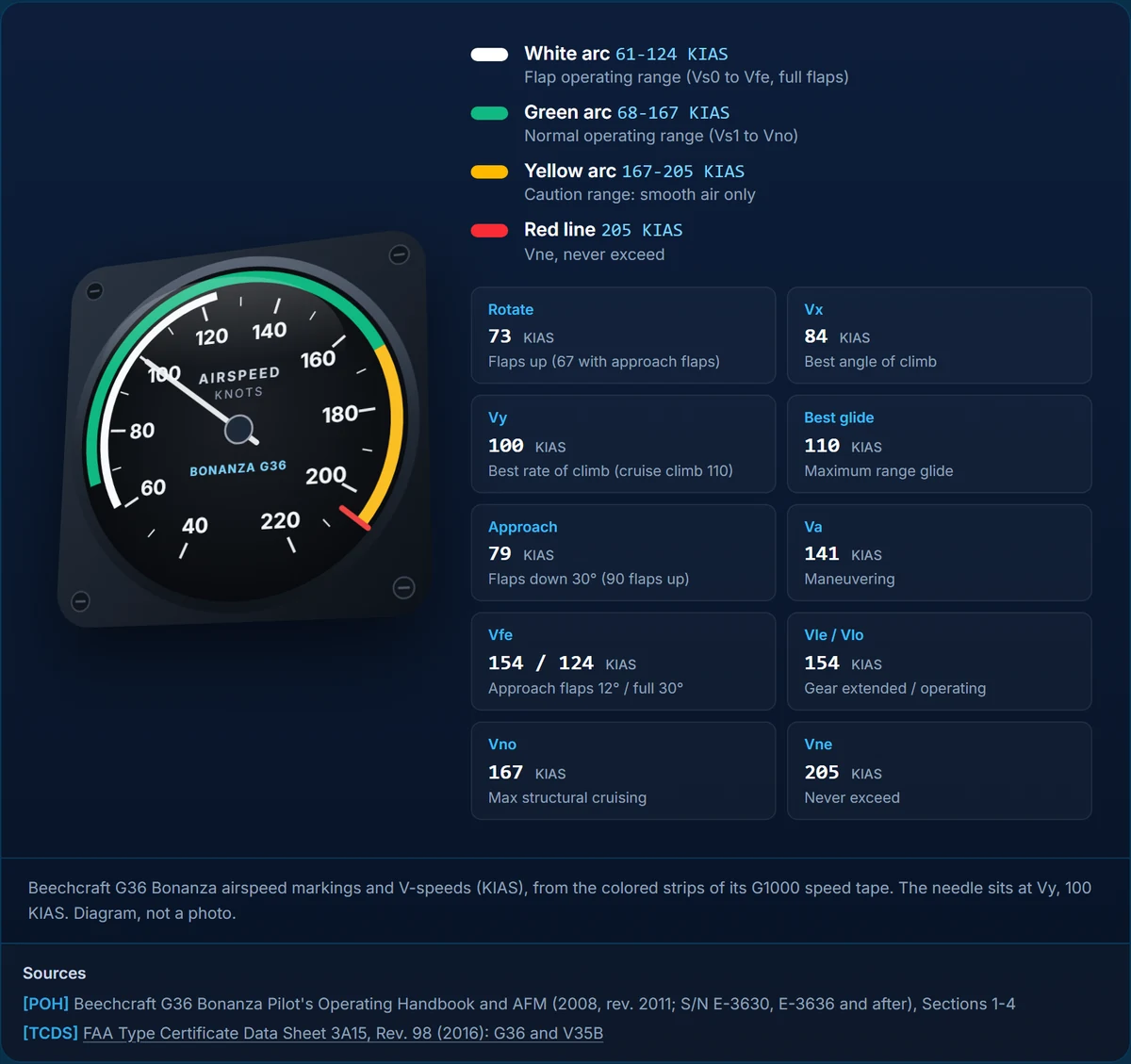
5. Bonanza G36 V-Speeds Reference
These V-speeds are for the Bonanza G36 with Continental IO-550-B engine at maximum gross weight of 3,650 lbs. Always refer to your specific aircraft's POH for exact values, as they may vary with weight and configuration.
| V-Speed | KIAS | Description |
|---|---|---|
| Vne | 203 | Never exceed speed |
| Vno | 167 | Maximum structural cruising speed |
| Va | 152 | Maneuvering speed (at max gross) |
| Vfe | 152 / 122 | Max flap extended (approach / full) |
| Vle | 152 | Max landing gear extended |
| Vlo (extend) | 152 | Max gear operating (extension) |
| Vlo (retract) | 122 | Max gear operating (retraction) |
| Vr | 71-80 | Rotation speed (varies with weight) |
| Vx | 82 | Best angle of climb |
| Vy | 100 | Best rate of climb |
| Vglide | 105 | Best glide speed (max gross) |
| Vref | 80-85 | Approach speed (normal landing) |
| Vs0 | 59 | Stall speed, landing configuration |
| Vs1 | 70 | Stall speed, clean configuration |
Study tip: Practice V-speeds for your aircraft type using our interactive study tools. Start for $7.49/mo and access flashcards, practice exams, and more.
6. Performance Data (G36)
The Bonanza G36 delivers impressive performance for a single-engine piston aircraft. With 300 horsepower and a clean retractable-gear design, it achieves speeds that rival many light twins while burning significantly less fuel. These figures are for standard atmospheric conditions at maximum gross weight unless otherwise noted.
| Metric | Value | Notes |
|---|---|---|
| Takeoff Ground Roll | 1,000 ft (305 m) | Sea level, standard day, max gross |
| Takeoff Distance (50 ft) | 1,880 ft (573 m) | Over 50-ft obstacle |
| Landing Ground Roll | 780 ft (238 m) | Sea level, standard day |
| Landing Distance (50 ft) | 1,500 ft (457 m) | Over 50-ft obstacle |
| Climb Rate at Sea Level | 1,230 fpm | Max gross weight |
| Climb Rate at 5,000 ft | 1,000 fpm | Standard atmosphere |
| Cruise Speed (75% power) | 176 KTAS | 8,000 ft, standard temp |
| Cruise Speed (65% power) | 168 KTAS | 10,000 ft, best economy |
| Cruise Speed (55% power) | 156 KTAS | 12,000 ft, long range |
| Fuel Flow (75%) | 15.2 GPH | 91 gallons/hour |
| Fuel Flow (65%) | 13.2 GPH | Best economy cruise |
| Fuel Flow (55%) | 11.5 GPH | Long range cruise |
| Range (74 gal, 75%) | 530 nm | No reserves |
| Range (74 gal, 55%) | 720 nm | No reserves |
| Endurance (74 gal, 55%) | 4.6 hours | Plus reserves |
One of the Bonanza's greatest strengths is its speed efficiency. At 176 knots true airspeed on 15.2 GPH, the G36 covers ground at nearly 12 nautical miles per gallon. For comparison, a Cessna 182 covers about 10.7 nm/gal at its 75%-power cruise of 145 KTAS on 13.5 GPH. The Bonanza gets you there faster and more fuel-efficiently on a per-mile basis.
The 1,230 fpm climb rate at sea level is robust for a 3,650-lb aircraft and ensures good obstacle clearance on departure. At density altitudes above 5,000 feet, expect climb rates around 800-1,000 fpm depending on temperature and weight. The 18,500-foot service ceiling provides comfortable cruising at 10,000-12,000 feet for oxygen-free operations, though many Bonanza owners carry supplemental oxygen for flights at 14,000-16,000 feet.
Plan your flight: Use our Weight & Balance Calculator to verify CG for your Bonanza loading scenario, or the Fuel Burn Calculator to plan fuel stops.
7. V-Tail vs Conventional Tail: The Full Story
The V-Tail Design
The Bonanza's V-tail (also called a butterfly tail or ruddervator) uses two angled surfaces instead of the traditional three (horizontal stabilizer, elevator, and vertical fin/rudder). Each V-tail surface acts as both an elevator and a rudder simultaneously through a mixing mechanism that combines pilot inputs. When the pilot pulls back on the yoke, both surfaces move symmetrically upward. When the pilot applies left rudder, the surfaces deflect differentially.
Aerodynamic Advantages
The theoretical advantage of the V-tail is reduced wetted area and interference drag. With two surfaces instead of three, there are fewer surface junctions where drag-producing boundary layers interact. In practice, this gives the V-tail Bonanza a 2-4 knot cruise speed advantage over the equivalent straight-tail model at the same power setting. V-tail proponents also note the cleaner aesthetics and the slight reduction in weight.
The "Doctor Killer" Myth
Perhaps no nickname in aviation has been more persistent -- or more unfair -- than the V-tail Bonanza's "Doctor Killer" label. The nickname originated in the 1950s through 1970s when the Bonanza, as the fastest and most expensive single-engine aircraft available, attracted affluent professionals (doctors, lawyers, business owners) who sometimes had more disposable income than flight experience.
The reality is that early V-tail models did experience a higher rate of in-flight structural failures compared to the straight-tail Debonair/Bonanza 33. Investigations traced the cause to the V-tail surfaces experiencing flutter at high speeds, particularly in turbulence. This was addressed through Airworthiness Directives requiring speed restrictions and the installation of reinforcing cuffs on the ruddervators.
With all ADs complied with, the V-tail Bonanza's structural safety record is equivalent to the conventional-tail version. The higher overall accident rate in early Bonanzas had more to do with pilot demographics -- inexperienced pilots flying high-performance aircraft in weather beyond their capabilities -- than any inherent design flaw. Modern V-tail Bonanzas with proper maintenance and well-trained pilots are thoroughly safe aircraft.
Handling Differences
V-tail Bonanzas have a distinctive handling characteristic: they tend to "wag their tails" in turbulence more than straight-tail versions. This is because the ruddervator mixing mechanism creates some coupling between yaw and pitch inputs. In smooth air, most pilots find the V-tail pleasantly responsive. In turbulence, the straight-tail A36/G36 provides a more stable, less busy ride.
Crosswind landings require slightly different technique in a V-tail, as the ruddervators respond differently to combined inputs than traditional rudder and elevator. Most pilots adapt quickly, but transition training is important for pilots new to the V-tail configuration.
Which Should You Choose?
For a first-time Bonanza buyer, the conventional-tail A36 or G36 is generally the better choice. Lower insurance costs, more predictable handling, the ability to add club seating (G36), and rear cargo door access make it the more practical aircraft. The V-tail is for pilots who have some Bonanza experience and appreciate the aesthetic, the slight speed advantage, and the heritage of flying the original configuration that Walter Beech envisioned.
8. New Bonanza G36 Pricing (2026)
The Bonanza G36 is one of the most expensive single-engine piston aircraft on the market, reflecting its premium positioning, build quality, and included Garmin G1000 NXi avionics suite. Textron Aviation builds each G36 to order at their Wichita, Kansas facility. Delivery times are typically 12-18 months.
| Item | Price |
|---|---|
| Base Price (G36, 2026) | $935,000+ |
| Garmin G1000 NXi (standard) | Included |
| GFC 700 Autopilot (standard) | Included |
| Air Conditioning | $28,000-$35,000 |
| Known Icing (TKS) | $40,000-$50,000 |
| Club Seating (standard on G36) | Included |
| Typical Equipped Price | $975,000-$1,050,000 |
Prices are approximate and subject to change. Contact your local Textron Aviation dealer for current pricing and option packages. Popular options include air conditioning, TKS known-icing protection, and premium interior materials.
9. Used Bonanza Prices (2026 Market)
The used Bonanza market is one of the most active segments in general aviation. With over 17,000 built, there is a wide selection available at nearly every price point. Values depend heavily on engine time, avionics, paint/interior condition, damage history, and total airframe hours.
| Model / Era | Typical Price | Notes |
|---|---|---|
| V35B (1968-1982) | $65,000-$140,000 | Wide range depending on engine time, mods, avionics |
| A36 (1968-1990) | $100,000-$200,000 | Most popular used variant. IO-520 or IO-550 |
| A36 (1990-2005) | $180,000-$350,000 | Later models with better avionics, IO-550 |
| B36TC (1979-2002) | $130,000-$280,000 | Turbocharged. Higher maintenance costs |
| G36 (2006-2015) | $400,000-$600,000 | G1000 equipped, glass cockpit |
| G36 (2016-2023) | $600,000-$850,000 | G1000 NXi, near-new condition |
Pre-Buy Inspection Tips
Never purchase a Bonanza without a thorough pre-buy inspection from an A&P/IA experienced with Beechcraft. Key areas to inspect include: the wing spar carry-through (especially on pre-1960 models with magnesium), landing gear actuators and microswitches, fuel bladder condition, engine compression and oil analysis history, V-tail bonding strips and ruddervator condition (V-tail models), and compliance with all Airworthiness Directives.
The American Bonanza Society (ABS) maintains a list of recommended mechanics and can help connect buyers with qualified inspectors. Their annual buyers guide provides model-by-model analysis of what to look for and what to avoid. Membership in ABS ($65/year) is a worthwhile investment for any Bonanza owner or prospective buyer.
10. Annual Operating Costs
Operating a Bonanza is more expensive than a Cessna 172 or Piper Cherokee, but reasonable for the performance class. The biggest variables are insurance (heavily dependent on pilot experience), fuel (15.2 GPH at 75% is thirsty), and unscheduled maintenance (retractable gear and constant-speed prop add complexity). These figures assume 150-200 flight hours per year.
| Category | Annual Cost | Per Hour | Notes |
|---|---|---|---|
| Fuel (75% power, $6.50/gal) | $14,800-$19,800 | $99 | 15.2 GPH, 150-200 hrs/yr |
| Insurance (Bonanza G36) | $3,500-$8,000 | $23-$53 | Varies hugely with experience |
| Insurance (V-tail, low time) | $6,000-$15,000 | $40-$100 | V-tail + low hours = expensive |
| Annual Inspection | $3,000-$6,000 | $20-$40 | More if gear/prop AD compliance |
| Engine Reserve | $5,400-$7,200 | $36-$48 | $36K-$48K overhaul / 2,000 hr TBO |
| Prop Reserve | $1,500-$2,000 | $10-$13 | $10K overhaul / 2,000 hr TBO |
| Hangar | $3,600-$12,000 | $24-$80 | Regional variation: $300-$1,000/mo |
| Avionics Updates/Database | $2,000-$4,000 | $13-$27 | G1000 database subscriptions |
| Miscellaneous/Unscheduled | $3,000-$5,000 | $20-$33 | Gear actuators, accessories |
Total Annual Cost Summary
Budget estimate (150 hrs/yr): $37,000-$59,000 per year ($247-$393 per hour)
Active owner (200 hrs/yr): $43,000-$68,000 per year ($215-$340 per hour)
These figures exclude hangar, loan payments, and depreciation. Actual costs vary significantly based on location, maintenance facility rates, and whether the aircraft experiences any unscheduled maintenance events.
11. Bonanza G36 vs Cirrus SR22
The Cirrus SR22 is the Bonanza's most direct modern competitor. Both are high-performance, $900K+ single-engine aircraft with glass cockpits, targeting the same buyer demographic. The comparison reveals two fundamentally different design philosophies: the Bonanza emphasizing traditional pilot skill and mechanical capability, the Cirrus emphasizing safety systems and composite technology.
| Specification | Bonanza G36 | Cirrus SR22T |
|---|---|---|
| Engine | Continental IO-550-B (300 HP) | Continental IO-550-N (310 HP) |
| Max Cruise Speed | 176 KTAS | 183 KTAS |
| Useful Load | ~1,195 lbs | ~1,043 lbs |
| Fuel Capacity | 74 gal | 92 gal |
| Range | 720 nm | 900+ nm |
| Seats | 6 (club seating) | 5 |
| Retractable Gear | Yes | No (fixed gear) |
| Parachute (CAPS) | No | Yes (whole-aircraft) |
| Avionics | Garmin G1000 NXi | Garmin Perspective Touch+ |
| New Price | ~$935,000+ | ~$890,000+ |
| Cabin Width | 42 in | 49 in |
| Baggage Capacity | 400 lbs (2 compts) | 130 lbs |
| Construction | All-metal (aluminum) | Composite |
| Known Icing Available | Yes (TKS option) | Yes (TKS option) |
| Insurance Cost | Higher (retractable) | Lower (CAPS credit) |
The Verdict
Choose the Bonanza G36 if you value: retractable gear, club seating for six, significantly more baggage capacity (400 lbs vs 130 lbs), and the satisfaction of flying a more mechanically complex aircraft. The Bonanza's two baggage compartments (including one accessible in flight) make it genuinely practical for family travel with luggage.
Choose the Cirrus SR22T if you value: the CAPS parachute system, wider cabin, longer range, lower insurance costs (CAPS credit), and a larger support network of standardized training partners. The Cirrus outsells the Bonanza by a significant margin, meaning parts availability and resale liquidity may be better.
For a deeper look at the SR22, see our Cirrus SR22 Complete Guide.
12. Bonanza G36 vs Cessna 182
The Cessna 182 Skylane is a common step-up aircraft for pilots transitioning from a 172. While it occupies a different performance tier than the Bonanza, many pilots compare the two because the used market offers overlap in pricing, and both serve as four-seat cross-country machines. The comparison reveals why the Bonanza commands a premium.
| Specification | Bonanza G36 | Cessna 182T |
|---|---|---|
| Engine | Continental IO-550-B (300 HP) | Lycoming IO-540-AB1A5 (230 HP) |
| Max Cruise Speed | 176 KTAS | 145 KTAS |
| Useful Load | ~1,195 lbs | ~1,010 lbs |
| Fuel Capacity | 74 gal | 92 gal |
| Range | 720 nm | 915 nm |
| Seats | 6 (club seating) | 4 |
| Retractable Gear | Yes | No (182T) / Yes (182RG) |
| Avionics | Garmin G1000 NXi | Garmin G1000 NXi (182T) |
| New Price | ~$935,000+ | Out of production (last ~$530K) |
| Used Price Range | $65K-$850K+ | $50K-$400K |
| Fuel Burn (75%) | 15.2 GPH | 13.5 GPH |
| Rate of Climb | 1,230 fpm | 924 fpm |
| Service Ceiling | 18,500 ft | 18,100 ft |
| Construction | All-metal | All-metal |
| High Wing vs Low Wing | Low wing | High wing |
The Bonanza is 31 knots faster, climbs 300 fpm better, carries two more passengers, and delivers substantially more useful load. The 182 counters with lower acquisition cost, simpler fixed-gear maintenance, high-wing visibility, and better short-field performance. For pilots who prioritize speed and carrying capacity, the Bonanza is the clear winner. For pilots who want a versatile, easy-to-fly, lower-cost cross-country machine, the 182 remains one of the best values in aviation.
Read our detailed comparison in the Cessna 172 Complete Guide.
13. Training & Transition Requirements
The Bonanza is not a beginner's aircraft. It demands respect, proper training, and genuine proficiency. The good news is that with appropriate instruction, the Bonanza is a straightforward aircraft to fly well. The transition from simpler aircraft to a Bonanza is one of the most rewarding upgrades a pilot can make.
High-Performance Endorsement
Required per 14 CFR 61.31(f) because the Bonanza exceeds 200 HP. Ground and flight training from an authorized instructor covering engine management, manifold pressure, cowl flaps, and high-speed operations.
Complex Endorsement
Required per 14 CFR 61.31(e) for all retractable-gear Bonanzas. Covers retractable landing gear, flaps, and controllable-pitch propeller operations.
Insurance Requirements
Most insurers require 10-25 hours of dual instruction in type before flying solo. Pilots with fewer than 500 total hours may face difficulty obtaining affordable coverage. Expect to provide 50-100+ hours of retractable-gear time for reasonable rates.
Transition Training (typical)
Plan for 10-15 hours of dual instruction covering: gear and flap operations, engine management, fuel system, weight and balance, short field and crosswind techniques, emergency procedures, and CG-sensitive handling.
Type-Specific Ground School
American Bonanza Society (ABS) offers excellent transition courses (BPPP - Bonanza Pilot Proficiency Program). Highly recommended for any new Bonanza owner or renter.
Instrument Proficiency
While not legally required for VFR flight, the Bonanza is most useful as an IFR platform. Budget for instrument proficiency training if you plan to use the aircraft for serious cross-country transportation.
Key Handling Characteristics
The Bonanza is a low-wing, retractable-gear aircraft with a relatively high wing loading. This means it is faster in cruise but also faster on approach than trainers like the Cessna 172. New Bonanza pilots often need to adjust to managing approach speeds, as the aircraft does not slow down as readily as lighter aircraft. Power management, speed discipline, and proper use of the landing-gear-down checklist are essential skills.
The Bonanza is CG-sensitive. With a rear CG (full rear seats, heavy baggage), the aircraft becomes lighter on the controls and may exhibit pitch sensitivity. Forward CG configurations provide more stability but require higher approach speeds. Always calculate weight and balance before every flight -- this is not optional in a Bonanza.
The Continental IO-550 engine requires proper leaning technique to prevent fouled spark plugs (run too rich) or excessive cylinder head temperatures (run too lean). Learn to use the engine monitor data on the G1000 to manage each cylinder individually. Lean of peak (LOP) operations are common in the Bonanza community and can extend engine life while reducing fuel consumption.
Study for your endorsements: Prepare for your high-performance and complex endorsements with Rotate's question bank covering systems, performance, and emergency procedures. Start studying for $7.49/mo
14. Common Maintenance Issues
The Bonanza is a well-built aircraft, but its retractable gear, constant-speed propeller, and high-performance engine add complexity compared to fixed-gear aircraft. Knowing the common maintenance items helps owners budget appropriately and catch issues before they become expensive surprises.
Landing Gear System
The Bonanza's electrically-actuated retractable landing gear is reliable but demands attention. Gear motor brushes wear over time, and the actuator rod-end bearings require periodic inspection. The gear position microswitches can become misadjusted, leading to unsafe gear indications. Budget $1,500-$3,000 for gear-related maintenance every few years. Always verify gear operation during pre-buy inspections.
Magnesium Spar Carry-Through (early models)
Pre-1960 V-tail Bonanzas used a magnesium alloy wing spar carry-through structure that is susceptible to corrosion, especially in humid coastal environments. This is a critical structural item. Later models switched to aluminum. Any pre-1960 Bonanza purchase must include a thorough carry-through inspection by a Bonanza-experienced A&P/IA.
V-Tail Ruddervator Cables and Bearings
V-tail models use ruddervators that combine rudder and elevator functions. The mixing mechanism, cables, and bearings in the tail assembly require careful inspection. Worn cables or binding bellcranks can cause control system issues. An Airworthiness Directive (AD 2003-18-15) requires repetitive inspection of the V-tail bonding strips. Budget $500-$1,000 per inspection cycle for V-tail specific maintenance.
Continental Engine Cylinder Issues
The Continental IO-520 and IO-550 engines powering most Bonanzas can develop cracked cylinders, especially at higher time. The IO-550 has improved metallurgy over the IO-520 but still requires careful monitoring via compression checks and borescope inspections. Cylinders cost $2,000-$3,500 each installed. Monitor oil analysis and compression closely.
Fuel System and Bladder Tanks
Bonanzas use bladder-style fuel cells that degrade over time and require replacement every 10-15 years at a cost of $5,000-$10,000 for the pair. Fuel leaks, wrinkled bladders, and fuel quantity sender inaccuracies are common in older aircraft. The fuel selector valve can also develop leaks with age.
Propeller AD Compliance
Hartzell propellers on Bonanzas are subject to several Airworthiness Directives requiring repetitive inspections and eventual replacement. The 3-blade prop on the G36 has a mandatory hub inspection interval. Propeller overhaul runs $8,000-$12,000; blade replacement can exceed $15,000.
Window and Windshield Crazing
The windshield and side windows on Bonanzas are prone to crazing (fine surface cracks) over time due to UV exposure and chemical contamination. A new windshield costs $2,000-$4,000 installed. Use only approved cleaning products and avoid ammonia-based cleaners.
Flap Actuator Motor
The electric flap motor and jackscrew can develop excessive play or fail entirely. Flap asymmetry, while rare, is a serious condition in any aircraft. Inspect for smooth flap operation across the full range and listen for unusual motor sounds. Replacement motors cost $1,500-$2,500.
Finding a Good Mechanic
Not all A&P mechanics are equally experienced with Bonanzas. The retractable gear system, fuel bladders, and model-specific ADs require specialized knowledge. Seek out mechanics who regularly work on Beechcraft products. The American Bonanza Society maintains a service clinic program and can recommend qualified shops in your area. Some of the best-known Bonanza maintenance facilities include Top Gun Aviation (Delaware), Stevens Aerospace (South Carolina), and Cutter Aviation (Arizona).
Annual inspection costs vary significantly by region and shop. Plan for $3,000-$6,000 for a standard annual, with the potential for significantly more if major discrepancies are found. First-year annuals on newly purchased aircraft often cost more as the new owner's mechanic addresses items the previous owner may have deferred.
15. Frequently Asked Questions
Why is the Bonanza called the 'Doctor Killer'?
Is the V-tail Bonanza safe to fly?
What is the difference between A36 and G36 Bonanza?
How much does a Beechcraft Bonanza cost?
What is the Bonanza's fuel burn rate?
How far can a Bonanza fly?
Is the Bonanza good for IFR flying?
How much does Bonanza insurance cost?
What is TBO on a Bonanza engine?
Should I buy a V-tail or straight-tail Bonanza?
Can you fly a Bonanza with a private pilot license?
What is the best Bonanza model to buy?
How does the Bonanza handle in turbulence?
What are common Bonanza ADs (Airworthiness Directives)?
Flying with the Garmin G1000 NXi?
The G36 Bonanza comes standard with the Garmin G1000 NXi integrated flight deck -- the same avionics suite used in the Cessna 172S, 182T, and many turboprops. Master the G1000 before your first flight with our comprehensive guide covering PFD, MFD, autopilot, flight planning, and system architecture.
Read the Garmin G1000 GuideRelated Guides
Cessna 172 Skyhawk Guide
The world's most popular trainer. Specs, V-speeds, and performance data.
Cirrus SR22 Complete Guide
The Bonanza's modern rival. CAPS, composite construction, and performance specs.
Garmin G1000 NXi Guide
Master the glass cockpit standard on the G36 Bonanza.
Weight & Balance Calculator
Calculate CG for your Bonanza loading scenario with our interactive tool.
Ready to Ace Your Checkride?
Whether you are studying for your high-performance endorsement, instrument rating, or commercial checkride, Rotate gives you access to thousands of practice questions, flashcards, and study materials covering aircraft systems, performance, and regulations.
Start for $7.49/mo$14.99/mo after first month. Cancel anytime.