← All Exam Prep Guides
FAAbeginnerCode: PAR

FAA Private Pilot (PAR) Exam Prep

The FAA Private Pilot Airplane knowledge test (PAR) has 60 questions with three answer choices each, 2 hours and a 70% passing score; 89.56% of 44,657 attempts passed in 2025. This guide covers what it tests, how to study, a week-by-week plan and 8 FAA sample questions with answers.

Could you pass the FAA private pilot written today?

5 hard questions on the real test topics — instant score, every answer explained. No signup.

Take the free test

The exam at a glance

FAA Private Pilot Airplane knowledge test (PAR)
Test codePAR[1]
Scored questions60 (plus 5 unscored validation questions)[2]
Time allowed2 hours (120 minutes)[1]
Passing score70%[1]
Answer choices3 per question (A, B, C)[3]
Test fee$175 plus tax per attempt (PSI voucher price)[4]
Minimum age to test15[1]
To take the testAn instructor endorsement or a pilot-school graduation certificate (14 CFR 61.35, 61.71).[1]
If you failAn instructor endorsement certifying additional training (14 CFR 61.49). No waiting period.[5]
Figures bookletFAA-CT-8080-2H[6]
StandardFAA-S-ACS-6C[7]
2025 pass rate89.56% of 44,657 attempts (average score 81.64%)[8]
  1. [1] FAA Airman Knowledge Testing Matrix (revised Sep 25, 2026)
  2. [2] PSI PAR applicant information bulletin
  3. [3] FAA airman knowledge test sample questions (Aug 2021)
  4. [4] PSI: FAA testing programs ($175 per knowledge test voucher)
  5. [5] 14 CFR 61.49: Retesting after failure
  6. [6] FAA airman knowledge testing supplements
  7. [7] FAA Airman Certification Standards
  8. [8] FAA CY2025 Airman Knowledge Test Volume Report
Where the points are
  • I. Preflight Preparation22%
  • II. Preflight Procedures13%
  • III. Airport and Seaplane Base Operations7%
  • IV. Takeoffs, Landings, and Go-Arounds20%
  • V. Performance and Ground Reference Maneuvers3%
  • VI. Navigation8%
  • VII. Slow Flight and Stalls8%
  • VIII. Basic Instrument Maneuvers7%
  • IX. Emergency Operations7%
  • XI. Night Operations3%
  • XII. Postflight Procedures2%

Share of the 60 scored questions per area. Source: PSI PAR applicant information bulletin.

About the PAR exam

The FAA Private Pilot Knowledge Test is the written exam required to earn a Private Pilot License (PPL) in the United States. It covers aeronautics fundamentals, regulations, navigation, weather, and flight operations. Most student pilots take this exam after completing ground school.

Before you book: An instructor endorsement or a ground-school graduation certificate (14 CFR 61.35); minimum age 15 to take the test. No medical certificate is needed for the knowledge test.

Topics Covered

1Regulations (14 CFR Parts 61, 91)
2Airspace & ATC procedures
3Weather theory & reports
4Aircraft performance & weight/balance
5Navigation (pilotage, dead reckoning, VOR)
6Aerodynamics & principles of flight
7Engine & systems
8Human factors & aeronautical decision making
9Flight operations & night flying
10Emergency procedures

8 FAA sample questions with answers

Published by the FAA itself, word for word. Try each one, then open the answer: the explanation and its source are ours.

1

Maintenance records show the last transponder inspection was performed on September 1, 2014. The next inspection will be due no later than

  1. ASeptember 30, 2015.
  2. BSeptember 1, 2016.
  3. CSeptember 30, 2016.
Show answer and explanation

Correct answer: C. September 30, 2016.

Under 14 CFR 91.413(a) a transponder must have been tested and inspected within the preceding 24 calendar months. Calendar months run to the end of the month, so an inspection on September 1, 2014 remains valid through the last day of September 2016: September 30, 2016. September 30, 2015 would be only 12 months, and September 1, 2016 ignores the calendar-month rule.

Source: 14 CFR 91.413(a)ACS PA.I.B.K1b
2

Why is frost considered hazardous to flight?

  1. AFrost changes the basic aerodynamic shape of the airfoils, thereby increasing lift.
  2. BFrost slows the airflow over the airfoils, thereby increasing control effectiveness.
  3. CFrost spoils the smooth flow of air over the wings, thereby decreasing lifting capability.
Show answer and explanation

Correct answer: C. Frost spoils the smooth flow of air over the wings, thereby decreasing lifting capability.

Frost roughens the wing surface and disrupts the smooth airflow over it, causing early airflow separation; as PHAK Ch. 12 explains, this reduces the wing's lifting capability and increases drag and stall speed, possibly preventing the airplane from becoming airborne. Frost never increases lift, and it does not improve control effectiveness.

Source: PHAK (FAA-H-8083-25)ACS PA.I.C.K3k

3

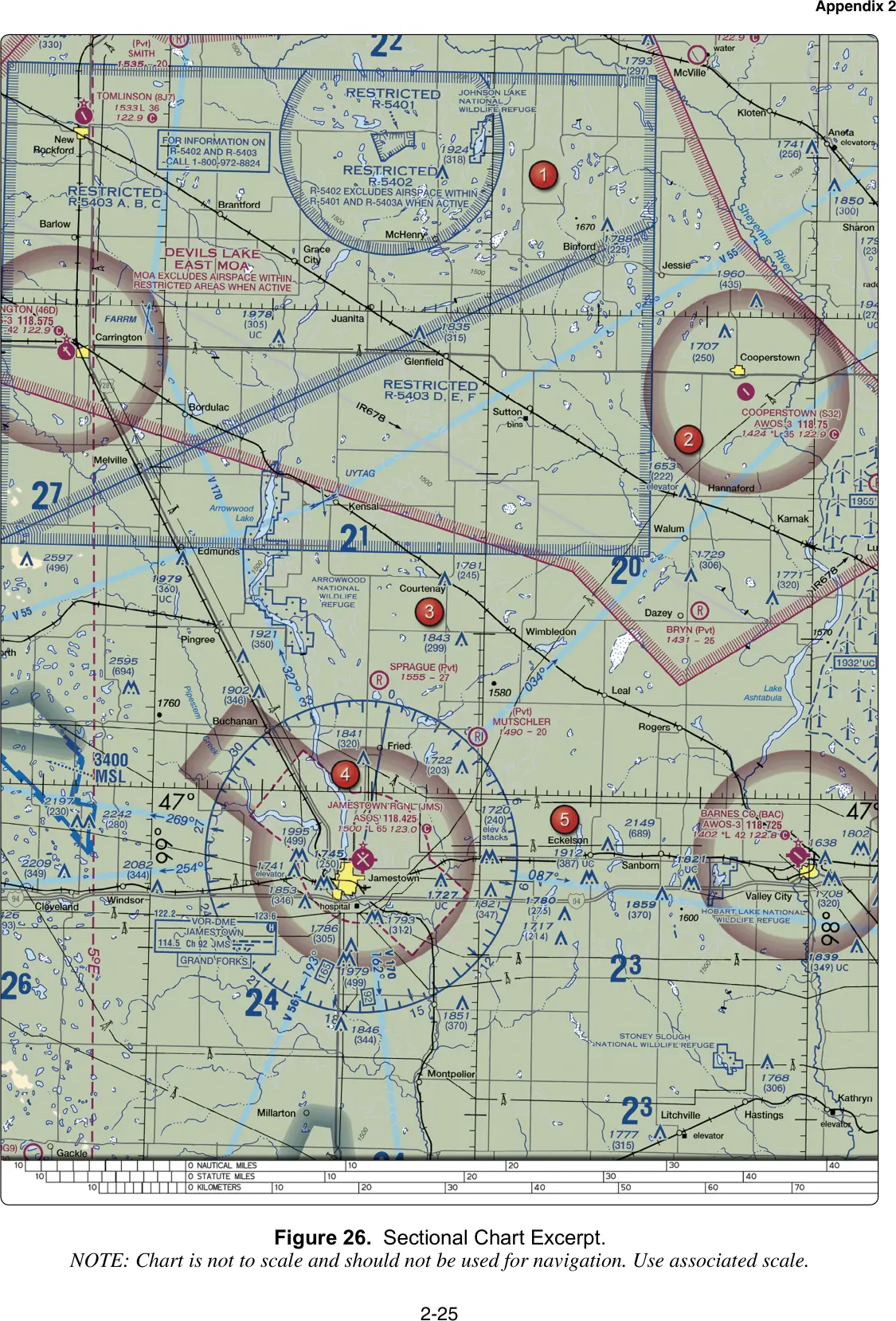
(Refer to FAA-CT-8080-2H, Figure 26, area 2.) The day VFR visibility and cloud clearance requirements to operate over the town of Cooperstown, after departing and climbing out of the Cooperstown Airport at or below 700 feet AGL are

Official FAA testing supplement figure for question 3: (Refer to FAA-CT-8080-2H, Figure 26, area 2.) The day VFR visibility and cloud clearance r
Official figure from the FAA airman knowledge testing supplement (public domain). Tap to open full size.
  1. A1 mile and clear of clouds.
  2. B1 mile and 1,000 feet above, 500 feet below, and 2,000 feet horizontally from clouds.
  3. C3 miles and clear of clouds.
Show answer and explanation

Correct answer: A. 1 mile and clear of clouds.

On Figure 26, Cooperstown Airport (S32) sits inside a magenta shaded vignette, meaning Class E airspace begins at 700 feet AGL, so the airspace at or below 700 feet AGL is Class G. For Class G at 1,200 feet AGL or less during the day, 14 CFR 91.155(a) requires 1 statute mile flight visibility and clear of clouds. The 3-mile and 1,000/500/2,000 cloud-clearance values are Class E (or Class G above 1,200 feet AGL) requirements.

Source: 14 CFR 91.155(a)ACS PA.I.E.K1

4

When speaking to a flight service weather briefer, you should state

  1. Athe pilot in command's full name and address.
  2. Ba summary of your qualifications.
  3. Cwhether the flight is VFR or IFR.
Show answer and explanation

Correct answer: C. whether the flight is VFR or IFR.

AIM 5-1-1 says that when requesting a preflight briefing you identify yourself as a pilot and provide the type of flight planned (VFR or IFR), the aircraft number or pilot's name, aircraft type, departure airport, route, destination, altitude, ETD and ETE, so the briefer can tailor the briefing. A home address and a summary of your qualifications are not part of that background information.

Source: AIM 5-1-1ACS PA.I.C.K1

5

What is one purpose of wing flaps?

  1. ATo enable the pilot to make steeper approaches to a landing without increasing the airspeed.
  2. BTo relieve the pilot of maintaining continuous pressure on the controls.
  3. CTo decrease wing area to vary the lift.
Show answer and explanation

Correct answer: A. To enable the pilot to make steeper approaches to a landing without increasing the airspeed.

Flaps are secondary flight controls that increase both lift and drag, so the airplane can fly a steeper descent angle toward the runway without picking up speed (PHAK Ch. 6; AFH Ch. 9). Relieving the pilot of continuous control pressure is the job of trim tabs, not flaps. Flaps also do not decrease wing area; extending them increases camber (and on some designs wing area) to change lift.

Source: PHAK (FAA-H-8083-25)ACS PA.I.G.K1b

6

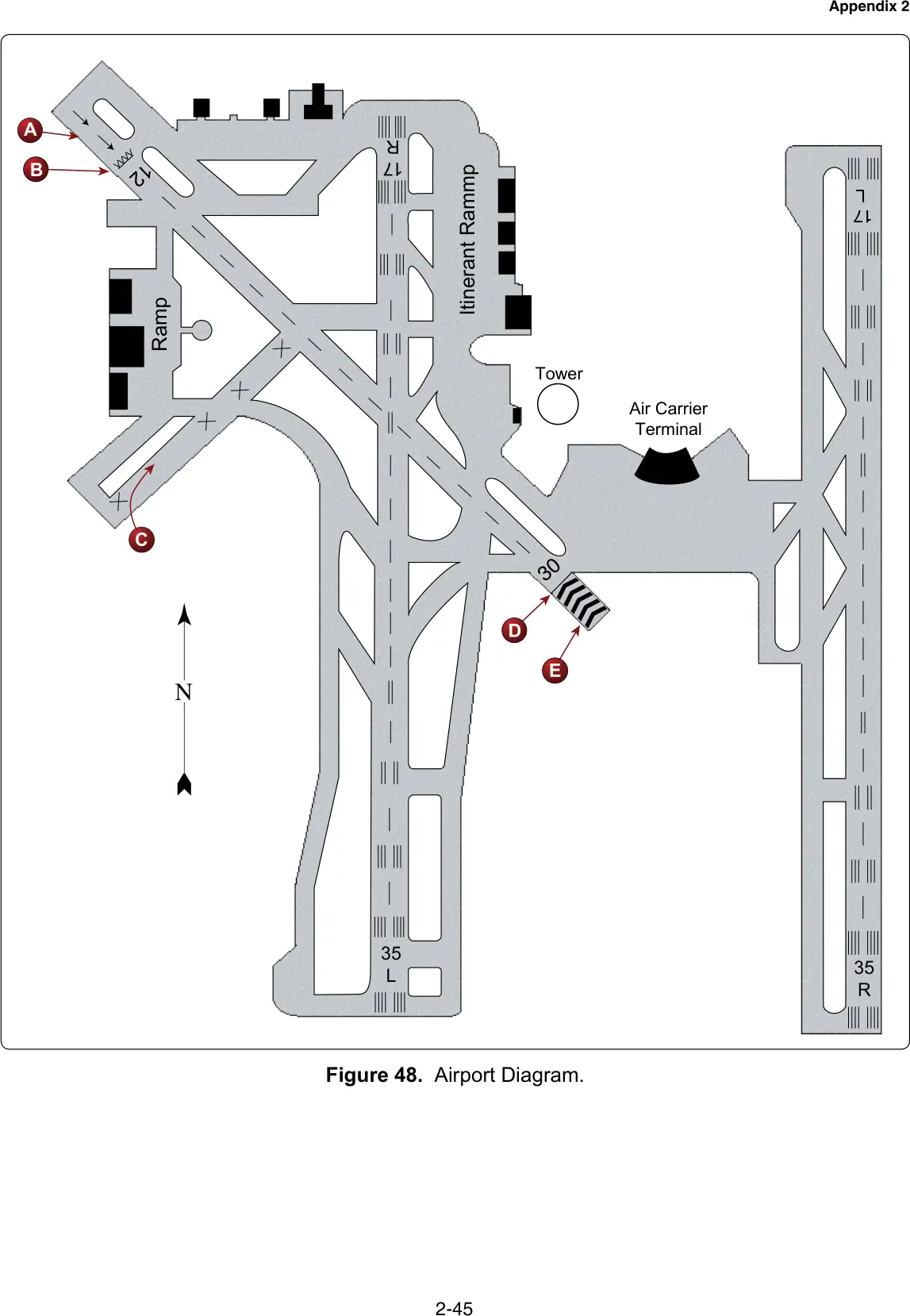
(Refer to FAA-CT-8080-2H, Figure 48.) The portion of the runway identified by the letter A may be used for

Official FAA testing supplement figure for question 6: (Refer to FAA-CT-8080-2H, Figure 48.) The portion of the runway identified by the letter A
Official figure from the FAA airman knowledge testing supplement (public domain). Tap to open full size.
  1. Alanding.
  2. Btaxiing and takeoff.
  3. Ctaxiing and landing.
Show answer and explanation

Correct answer: B. taxiing and takeoff.

Area A on Figure 48 is the paved runway section before Runway 12's threshold, marked with white arrows along the centerline and arrowheads ahead of the threshold bar. That is a displaced threshold. Per AIM 2-3-3 and PHAK Ch. 14, the pavement behind a displaced threshold is available for taxiing and for takeoffs in either direction. An aircraft landing on Runway 12 may not touch down there; only the rollout of an aircraft landing in the opposite direction may use it. So it is correctly described as usable for taxiing and takeoff, not for landing.

Source: AIM 2-3-3 · PHAK (FAA-H-8083-25)ACS PA.II.D.K3

7

What does the red line on an airspeed indicator represent?

  1. AManeuvering speed.
  2. BTurbulent or rough-air speed.
  3. CNever-exceed speed.
Show answer and explanation

Correct answer: C. Never-exceed speed.

The red radial line on an airspeed indicator marks VNE, the never-exceed speed; operating above it can cause structural damage or failure (PHAK Ch. 8). Maneuvering speed (VA) is not marked on the airspeed indicator, and the caution range for smooth air only is the yellow arc, whose lower end is VNO, the maximum structural cruising speed.

Source: PHAK (FAA-H-8083-25)ACS PA.I.F.R2

8

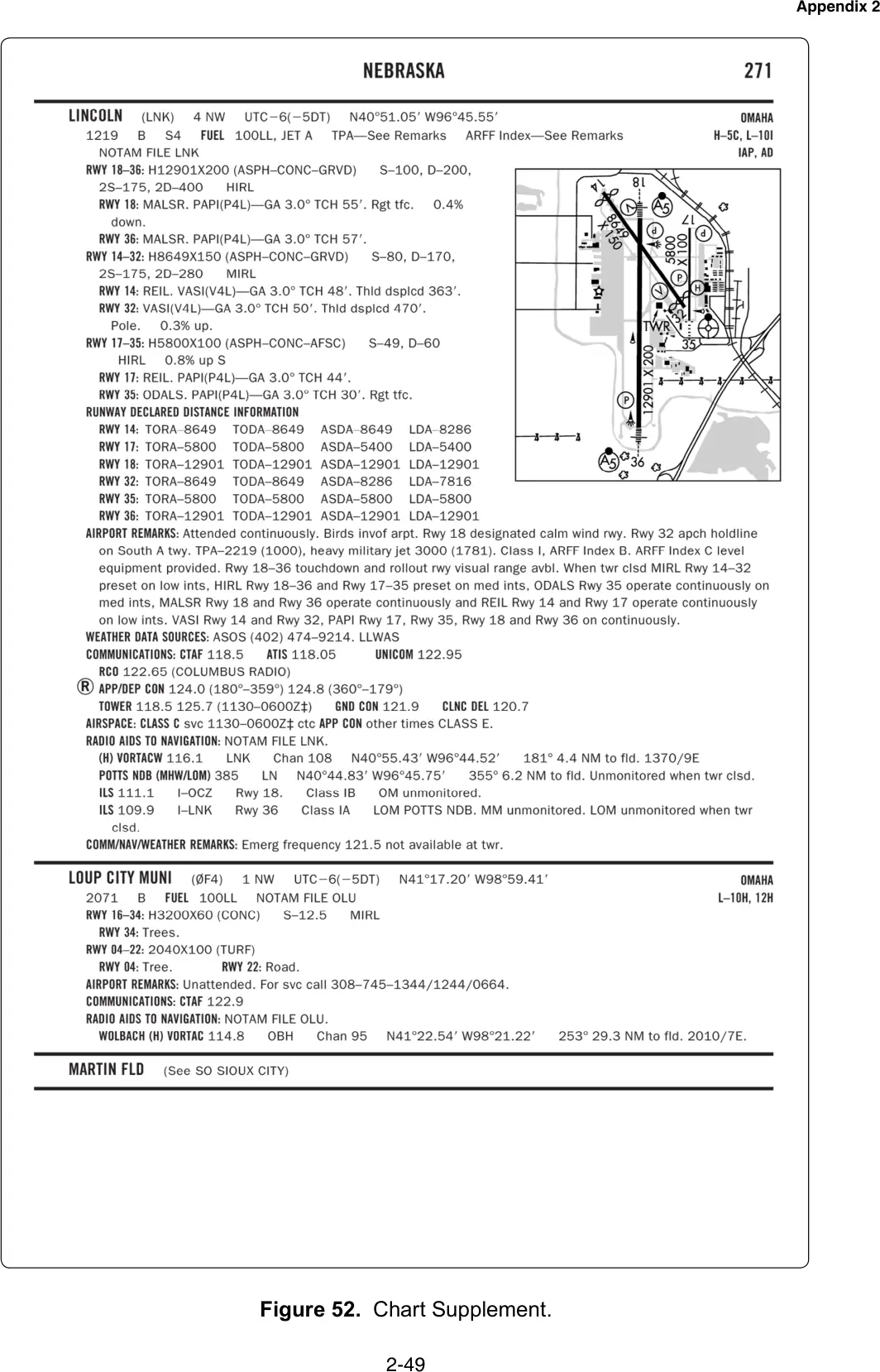
(Refer to FAA-CT-8080-2H, Figure 52.) What is the recommended communications procedure for landing at Lincoln Municipal during the hours when the tower is not in operation?

Official FAA testing supplement figure for question 8: (Refer to FAA-CT-8080-2H, Figure 52.) What is the recommended communications procedure for
Official figure from the FAA airman knowledge testing supplement (public domain). Tap to open full size.
  1. AMonitor airport traffic and announce your position and intentions on 118.5 MHz.
  2. BContact UNICOM on 122.95 MHz for traffic advisories.
  3. CMonitor ATIS for airport conditions, then announce your position on 122.95 MHz.
Show answer and explanation

Correct answer: A. Monitor airport traffic and announce your position and intentions on 118.5 MHz.

The Lincoln Chart Supplement entry lists CTAF 118.5, the same frequency as the tower, which operates only 1130-0600Z. When the tower is closed, AIM 4-1-9 calls for pilots to monitor the CTAF and self-announce position and intentions on it, so reports go out on 118.5 MHz. The UNICOM frequency 122.95 is for airport services and advisories, not the CTAF at this airport.

Source: AIM 4-1-9ACS PA.III.A.K2

See 60 FAA questions with answers on one page

Expert Study Tips

1

Focus heavily on FAR/AIM — regulations make up ~25% of the exam

2

Master sectional chart interpretation and E6B calculations

3

Learn weather products: METARs, TAFs, prog charts, and AIRMETs/SIGMETs

4

Practice weight and balance problems until they are automatic

5

Use the FAA Airman Knowledge Testing Supplement during your study

6

Take practice tests until you consistently score 85%+ before the real exam

Suggested Study Timeline

1

Weeks 1-2

Read through all study materials and take notes on key concepts

2

Weeks 3-4

Focus on weak areas identified from initial study, create flashcards

3

Weeks 5-6

Take full-length practice tests, review all incorrect answers

4

Week 7

Final review of trouble areas, take 2-3 practice exams scoring 85%+

5

Week 8

Light review only, schedule and take the exam

Recommended Resources

  • FAA Pilot's Handbook of Aeronautical Knowledge (FAA-H-8083-25B)
  • FAA Airplane Flying Handbook (FAA-H-8083-3C)
  • 14 CFR Parts 61 and 91
  • Aeronautical Information Manual (AIM)

More practice by subject

FAA Private Pilot (PAR): FAQ

How many questions are on the FAA Private Pilot (PAR) exam?

60 questions plus 5 unscored validation questions, 2 hours (120 minutes) and 70% to pass, with three answer choices per question (FAA Airman Knowledge Testing Matrix).

What is the PAR pass rate?

89.56% of 44,657 attempts passed in 2025, with an average score of 81.64% (FAA CY2025 Airman Knowledge Test Volume Report).

What do I need to take the PAR test?

An instructor endorsement or a pilot-school graduation certificate (14 CFR 61.35, 61.71).

What happens if I fail the PAR test?

An instructor endorsement certifying additional training (14 CFR 61.49). No waiting period.

How much does the FAA Private Pilot (PAR) exam cost?

PSI sells FAA knowledge test vouchers at $175 plus tax per attempt; the FAA quotes about $175 for the Part 107 test. Study materials and training are extra.

Ready to start studying?

Five hard questions, an instant score and every answer explained. No signup.

Take the free test
Renzo Madueño

Written and reviewed by Renzo Madueño

Former Airbus A320 First Officer (Avianca), FAA commercial pilot · Founder, Rotate Pilot

The questions are the FAA's own words. The FAA does not publish an answer key, so each answer here was worked out against the regulations and handbooks in force today, and every explanation names its source so you can check it yourself. Questions whose answer changed with newer rules were left out. Found something wrong? Tell us and we fix it.

Last reviewed . Rotate Pilot is independent and not affiliated with the FAA, PSI or any aviation authority.

More FAA Exams