The FAA Instrument Rating Airplane knowledge test (IRA) has 60 questions with three answer choices each, 2 hours and a 70% passing score; 94.38% of 27,143 attempts passed in 2025. This guide covers what it tests, how to study, a week-by-week plan and 8 FAA sample questions with answers.
The FAA Instrument Rating Knowledge Test evaluates a pilot's understanding of instrument flight rules, procedures, and navigation. You need it, with the practical test, before you can fly under IFR as pilot in command.
Before you book: Private pilot certificate, instrument ground school or instructor endorsement
Published by the FAA itself, word for word. Try each one, then open the answer: the explanation and its source are ours.
1
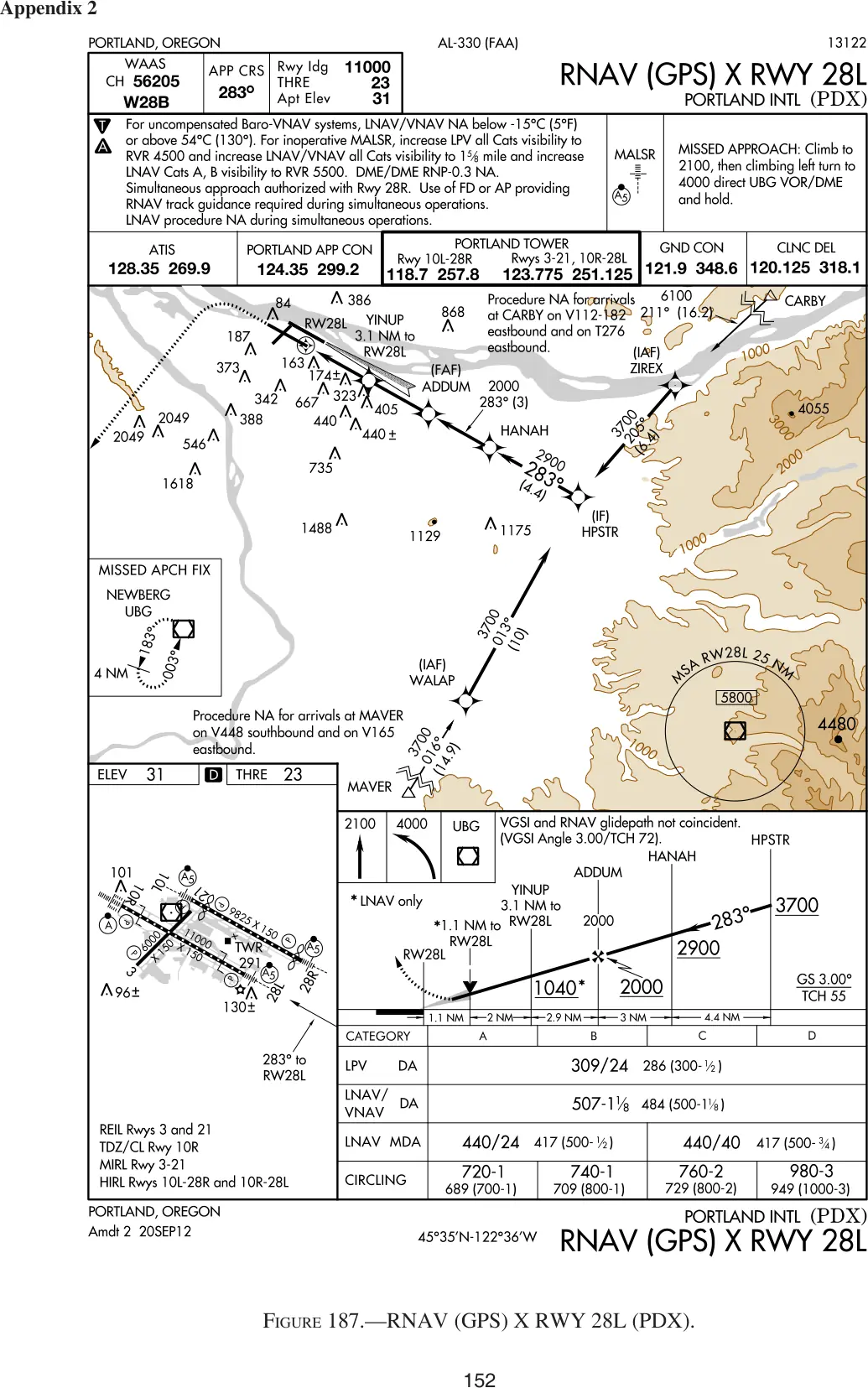
(Refer to FAA-CT-8080-3F, Figure 187.) When conducting a missed approach from the RNAV (GPS) X RWY 28L approach at PDX, what is the Minimum Safe Altitude (MSA) while maneuvering?
Official figure from the FAA airman knowledge testing supplement (public domain). Tap to open full size.
A2,100 feet MSL.
B4,000 feet MSL.
C5,800 feet MSL.
Show answer and explanation
Correct answer: C. 5,800 feet MSL.
The plan view of the PDX RNAV (GPS) X RWY 28L chart shows a single-sector Minimum Safe Altitude of 5,800 feet MSL within 25 NM of RW28L. Per AIM 5-4-5 the MSA provides 1,000 feet of obstacle clearance for emergency use within that radius. 2,100 feet is the initial climb altitude of the missed approach and 4,000 feet is the holding altitude at UBG.
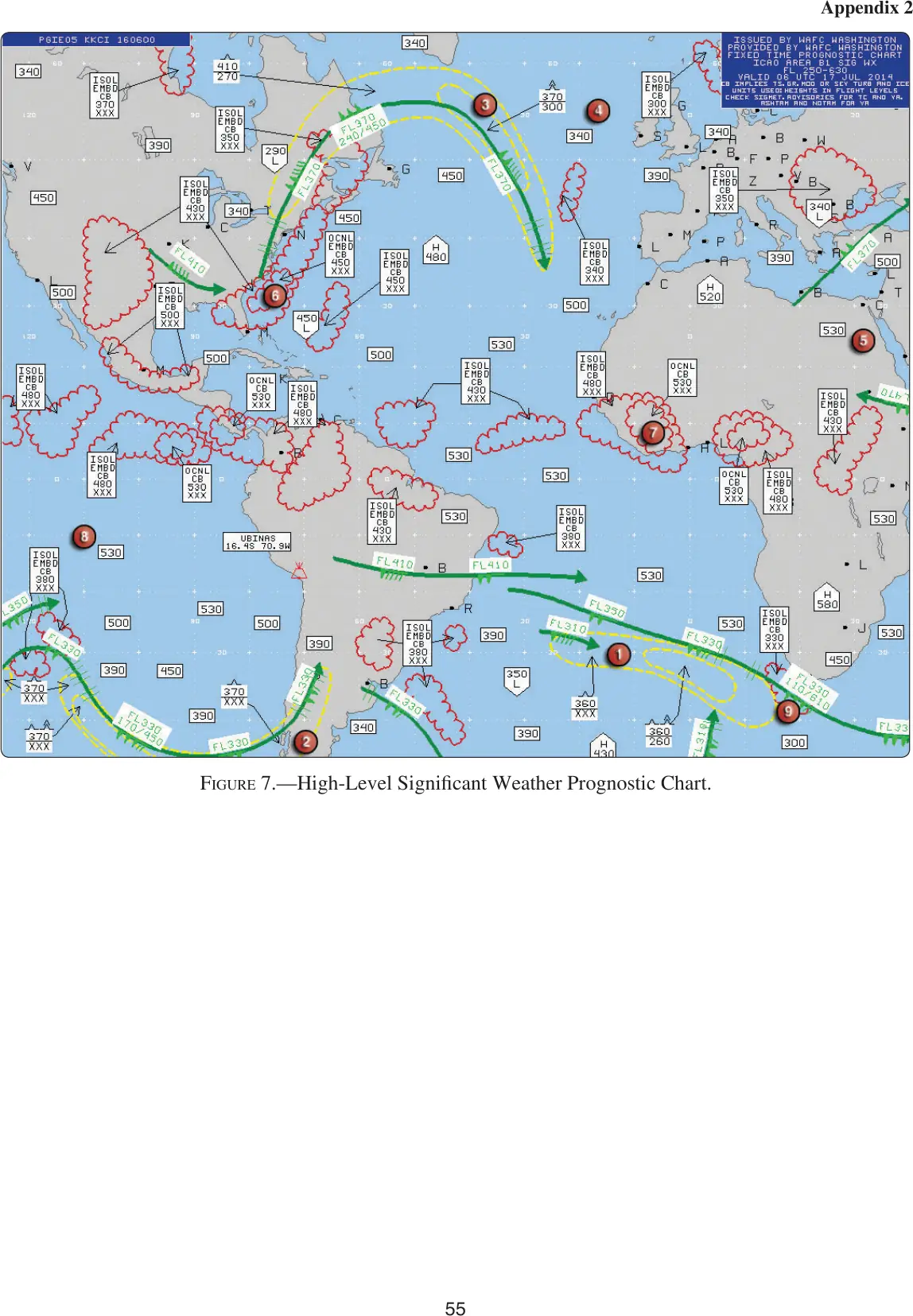
(Refer to FAA-CT-8080-3F, Figure 7.) What type of weather can be expected in the red scalloped area near area 9?
Official figure from the FAA airman knowledge testing supplement (public domain). Tap to open full size.
A2/8 to 6/8 coverage, occasional embedded thunderstorms, tops at FL 330.
B1/8 to 4/8 coverage, occasional embedded thunderstorms, maximum tops at 51,000 feet MSL.
CIsolated embedded cumulonimbus with tops to FL330.
Show answer and explanation
Correct answer: C. Isolated embedded cumulonimbus with tops to FL330.
The red scalloped area next to marker 9 on Figure 7 is labeled 'ISOL EMBD CB 330/XXX': isolated cumulonimbus embedded in other cloud, tops FL330, and bases below the chart's FL250 lower limit (XXX). Per the Aviation Weather Handbook (27.8.3.2.1), ISOL and OCNL are distinct coverage categories, so descriptions of 'occasional' coverage or tops of 51,000 feet do not match this box.
Aobstacle clearance, accurate navigational signals from more than one VORTAC, and accurate DME mileage.
Ba 1,000-foot obstacle clearance within 2 miles of an airway and assures accurate DME mileage.
Cacceptable navigational signal coverage and meets obstruction clearance requirements.
Show answer and explanation
Correct answer: C. acceptable navigational signal coverage and meets obstruction clearance requirements.
14 CFR 1.1 defines the MEA as the lowest published altitude between radio fixes that assures acceptable navigational signal coverage and meets obstacle clearance requirements between those fixes. It does not guarantee reception of more than one VORTAC or accurate DME. It says nothing about a 1,000-foot clearance within 2 miles of an airway..
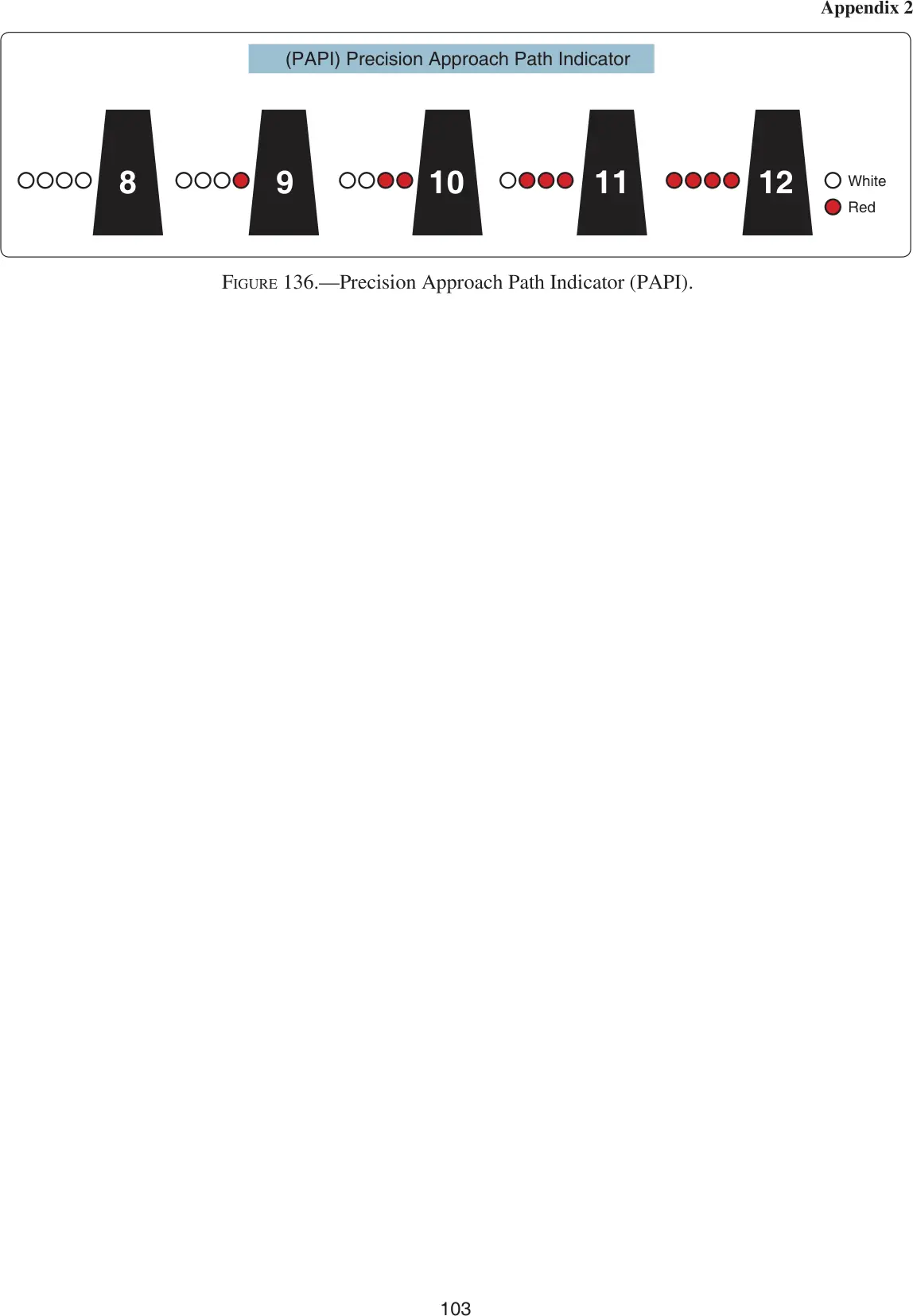
(Refer to FAA-CT-8080-3F, Figure 136.) An 'on glidepath' indication is
Official figure from the FAA airman knowledge testing supplement (public domain). Tap to open full size.
A8
B10
C11
Show answer and explanation
Correct answer: B. 10
A four-light PAPI shows on glide path when the two outer lights are white and the two inner lights are red (AIM 2-1-2). In Figure 136, that is indication 10 (two white, two red). Indication 8 (four white) is well above the glide path, and 11 (one white, three red) is slightly below it.
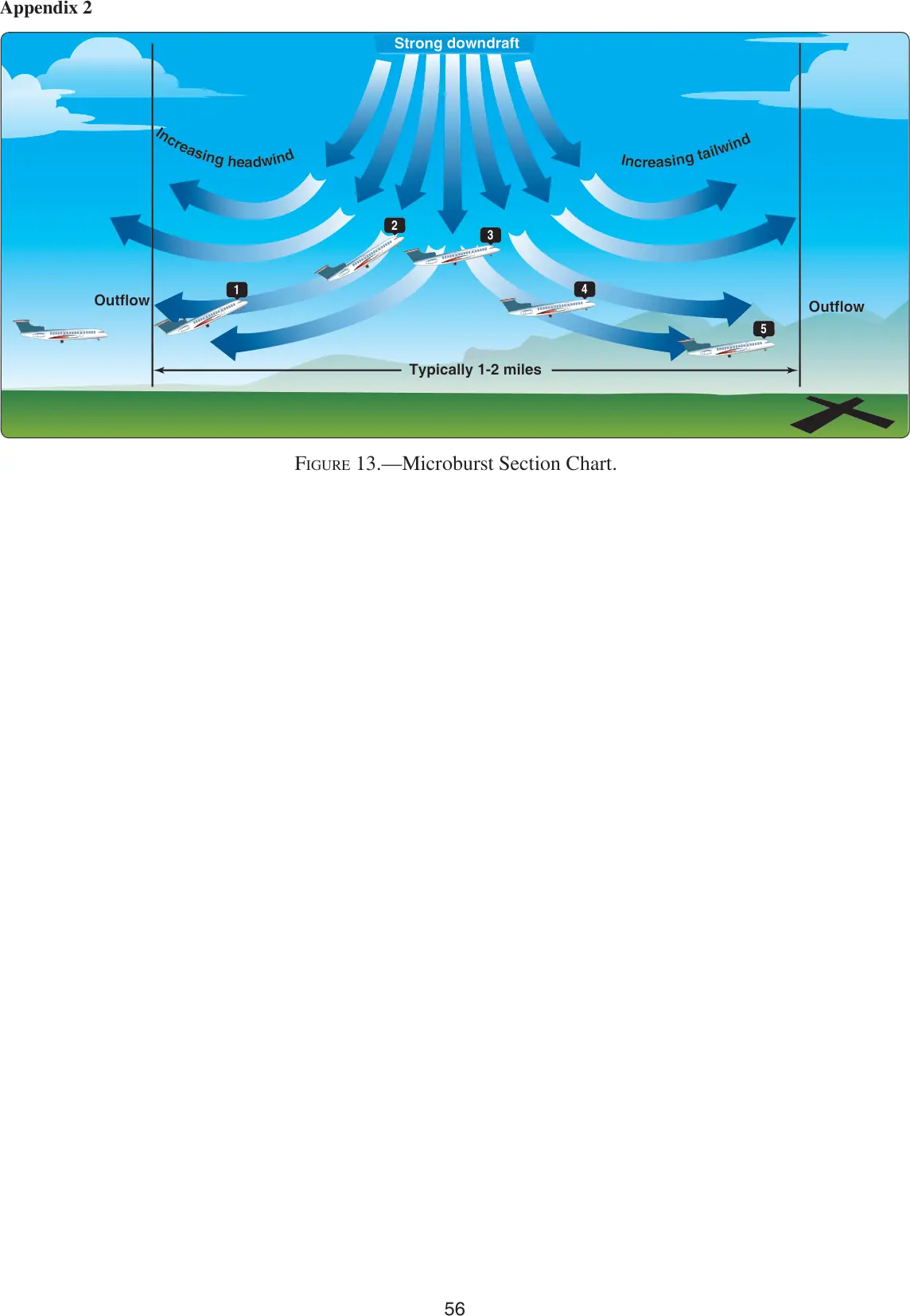
(Refer to FAA-CT-8080-3F, Figure 13.) How will the aircraft in position 4 be affected by a microburst encounter?
Official figure from the FAA airman knowledge testing supplement (public domain). Tap to open full size.
APerformance increasing with a tailwind and updraft.
BPerformance decreasing with a tailwind and downdraft.
CPerformance decreasing with a headwind and downdraft.
Show answer and explanation
Correct answer: B. Performance decreasing with a tailwind and downdraft.
In Figure 13 the aircraft flies left to right through the microburst: at position 1 it meets the increasing headwind, at 3 the strong downdraft at the core, and at 4 it is past the center in the increasing tailwind while still under the downward-curving outflow. AIM 7-1-24 says the downdraft and tailwind are both performance-decreasing, so at position 4 performance is decreasing with a tailwind and downdraft. The headwind (performance-increasing) part occurs on the entry side, not at position 4.
To act as pilot in command of an aircraft under IFR, what is the minimum instrument flight experience you must have logged during the preceding six months, in the same category of aircraft?
AHolding procedures, intercepting and tracking courses through the use of navigation systems, and six instrument approaches.
BSix hours of instrument time in any aircraft, and six instrument approaches.
CSix instrument approaches, three of which must be in the same category and class of aircraft to be flown, and 6 hours of instrument time in any aircraft.
Show answer and explanation
Correct answer: A. Holding procedures, intercepting and tracking courses through the use of navigation systems, and six instrument approaches.
To act as PIC under IFR, 14 CFR 61.57(c)(1) requires that within the preceding 6 calendar months you performed and logged, in actual or simulated instrument conditions in the appropriate category of aircraft: six instrument approaches, holding procedures and tasks, and intercepting and tracking courses using navigation systems. The current rule has no requirement for 6 hours of instrument time, which was an older version of the rule. The approaches are not split by class.
Military training routes (MTR) above 1,500 feet are depicted on
AIFR Planning Charts.
BIFR Low Altitude En Route Charts.
CIFR High Altitude En Route Charts.
Show answer and explanation
Correct answer: B. IFR Low Altitude En Route Charts.
AIM 3-5-2 states that the IFR Enroute Low Altitude Chart depicts all IR routes and all VR routes that accommodate operations above 1,500 feet AGL; sectional charts also show MTR information. MTRs are low-altitude routes (generally below 10,000 feet MSL), so they are not a high altitude chart item, and IFR Planning Charts are not their charting product.
If both the ram air input and drain hole of the pitot system become blocked, the indicated airspeed will
Aincrease during a climb.
Bdecrease during a climb.
Cremain constant regardless of altitude change.
Show answer and explanation
Correct answer: A. increase during a climb.
PHAK Chapter 8 explains that with both the pitot ram inlet and the drain hole blocked, the air pressure trapped in the pitot line stays constant, so the airspeed indicator behaves like an altimeter. As the aircraft climbs, static pressure falls while the trapped pitot pressure does not, so the indicated airspeed increases (and decreases in a descent) regardless of actual airspeed.
How many questions are on the FAA Instrument Rating (IRA) exam?
60 questions plus 5 unscored validation questions, 2 hours (120 minutes) and 70% to pass, with three answer choices per question (FAA Airman Knowledge Testing Matrix).
What is the IRA pass rate?
94.38% of 27,143 attempts passed in 2025, with an average score of 86.15% (FAA CY2025 Airman Knowledge Test Volume Report).
What do I need to take the IRA test?
An instructor endorsement or a pilot-school graduation certificate (14 CFR 61.65(a)(4), 61.71(a)).
What happens if I fail the IRA test?
An instructor endorsement certifying additional training (14 CFR 61.49). No waiting period.
How much does the FAA Instrument Rating (IRA) exam cost?
PSI sells FAA knowledge test vouchers at $175 plus tax per attempt; the FAA quotes about $175 for the Part 107 test. Study materials and training are extra.
Ready to start studying?
Five hard questions, an instant score and every answer explained. No signup.
Former Airbus A320 First Officer (Avianca), FAA commercial pilot · Founder, Rotate Pilot
The questions are the FAA's own words. The FAA does not publish an answer key, so each answer here was worked out against the regulations and handbooks in force today, and every explanation names its source so you can check it yourself. Questions whose answer changed with newer rules were left out. Found something wrong? Tell us and we fix it.
Last reviewed . Rotate Pilot is independent and not affiliated with the FAA, PSI or any aviation authority.