← All Exam Prep Guides
FAAintermediateCode: CAX

FAA Commercial Pilot (CAX) Exam Prep

The FAA Commercial Pilot Airplane knowledge test (CAX) has 100 questions with three answer choices each, 2.5 hours and a 70% passing score; 99.17% of 20,530 attempts passed in 2025. This guide covers what it tests, how to study, a week-by-week plan and 8 FAA sample questions with answers.

Check your FAA written fundamentals — free

5 hard questions on the airspace, weather and regs every rating builds on. Instant score, no signup.

Take the free test

The exam at a glance

FAA Commercial Pilot Airplane knowledge test (CAX)
Test codeCAX[1]
Scored questions100 (plus 5 unscored validation questions)[2]
Time allowed2.5 hours (150 minutes)[1]
Passing score70%[1]
Answer choices3 per question (A, B, C)[3]
Test fee$175 plus tax per attempt (PSI voucher price)[4]
Minimum age to test16[1]
To take the testAn instructor endorsement or a ground-school graduation certificate (14 CFR 61.35).[1]
If you failAn instructor endorsement certifying additional training (14 CFR 61.49). No waiting period.[5]
Figures bookletFAA-CT-8080-1E[6]
StandardFAA-S-ACS-7B[7]
2025 pass rate99.17% of 20,530 attempts (average score 91.25%)[8]
  1. [1] FAA Airman Knowledge Testing Matrix (revised Sep 25, 2026)
  2. [2] PSI CAX applicant information bulletin
  3. [3] FAA airman knowledge test sample questions (Aug 2021)
  4. [4] PSI: FAA testing programs ($175 per knowledge test voucher)
  5. [5] 14 CFR 61.49: Retesting after failure
  6. [6] FAA airman knowledge testing supplements
  7. [7] FAA Airman Certification Standards
  8. [8] FAA CY2025 Airman Knowledge Test Volume Report
Where the points are
  • I. Preflight Preparation24%
  • II. Preflight Procedures15%
  • III. Airport and Seaplane Base Operations9%
  • IV. Takeoffs, Landings, and Go-Arounds15%
  • V. Performance and Ground Reference Maneuvers2%
  • VI. Navigation10%
  • VII. Slow Flight and Stalls12%
  • VIII. High Altitude Operations3%
  • IX. Emergency Operations9%
  • XI. Postflight Procedures1%

Share of the 100 scored questions per area. Source: PSI CAX applicant information bulletin.

About the CAX exam

The FAA Commercial Pilot Knowledge Test is required to earn a Commercial Pilot License (CPL). It covers advanced aerodynamics, regulations for commercial operations, performance calculations, and professional flight operations. Passing this allows you to fly for hire.

Before you book: Private pilot certificate, instrument rating recommended, 250 hours total time, ground school or endorsement

Topics Covered

1Commercial pilot regulations (14 CFR Parts 61, 91, 119, 135)
2Advanced aerodynamics and performance
3Complex and high-performance aircraft operations
4Advanced weight and balance
5Commercial flight operations
6Night and high-altitude operations
7Advanced weather and meteorology
8Navigation and flight planning
9Emergency procedures
10Aeronautical decision-making

8 FAA sample questions with answers

Published by the FAA itself, word for word. Try each one, then open the answer: the explanation and its source are ours.

1

You are pilot-in-command of a VFR flight that you think will be within the fuel range of your aircraft. As part of your preflight planning you must

  1. Abe familiar with all instrument approaches at the destination airport.
  2. Blist an alternate airport on the flight plan, and confirm adequate takeoff and landing performance at the destination airport.
  3. Cobtain weather reports, forecasts, and fuel requirements for the flight.
Show answer and explanation

Correct answer: C. obtain weather reports, forecasts, and fuel requirements for the flight.

14 CFR 91.103(a) requires the pilot in command, for any flight not in the vicinity of an airport, to become familiar with weather reports and forecasts, fuel requirements, and alternatives available if the flight cannot be completed as planned. Knowing every instrument approach is not required for a VFR flight, and a VFR flight plan does not require an alternate airport.

Source: 14 CFR 91.103(a)ACS CA.I.C.K3
2

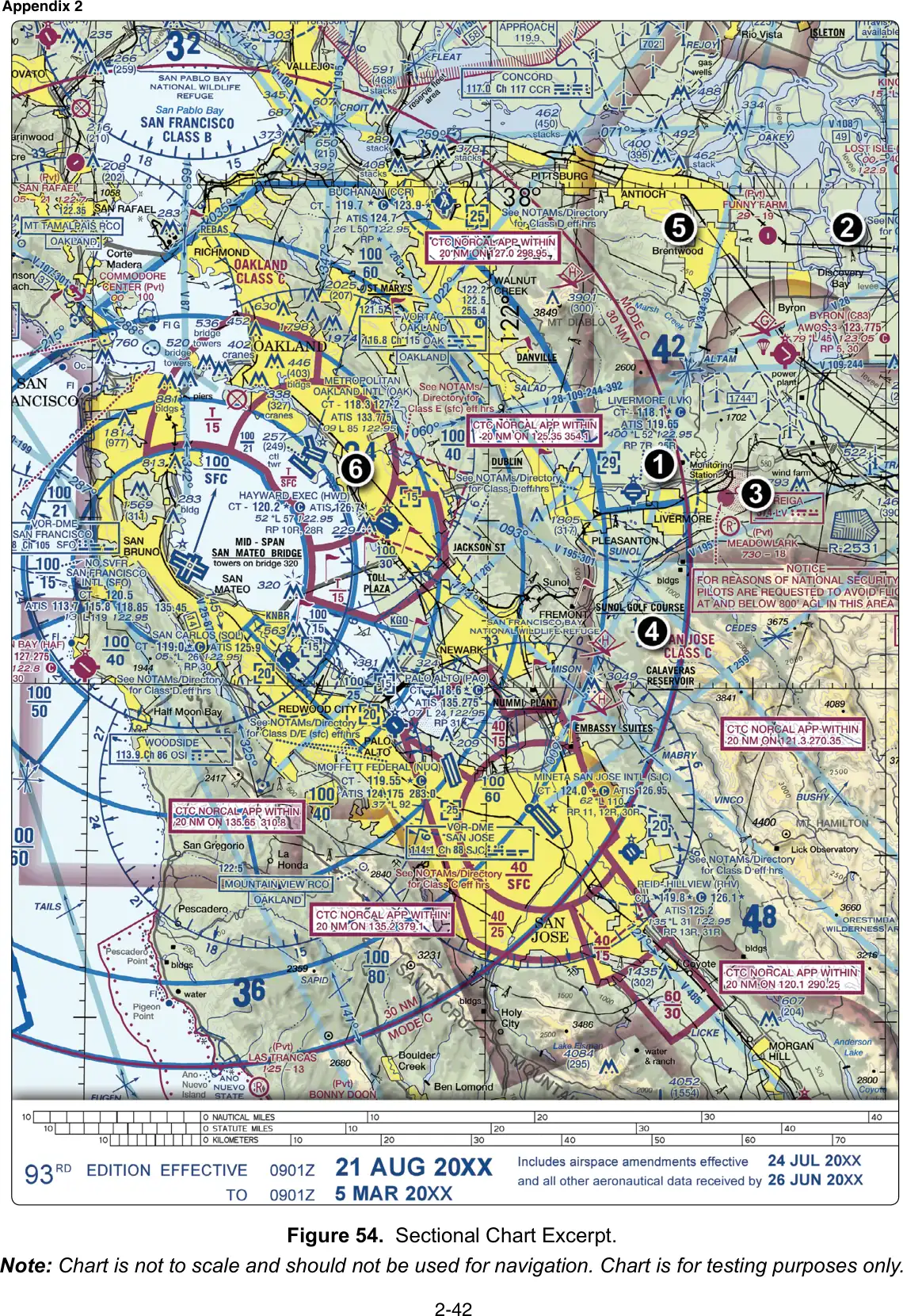
(Refer to FAA-CT-8080-1E, Figure 54, Area 3.) What is the significance of R-2531? This is a restricted area

Official FAA testing supplement figure for question 2: (Refer to FAA-CT-8080-1E, Figure 54, Area 3.) What is the significance of R-2531? This is
Official figure from the FAA airman knowledge testing supplement (public domain). Tap to open full size.
  1. Afor IFR aircraft.
  2. Bwhere aircraft may never operate.
  3. Cwhere often invisible hazards exist.
Show answer and explanation

Correct answer: C. where often invisible hazards exist.

AIM 3-4-3 describes restricted areas as airspace that denotes the existence of unusual, often invisible, hazards to aircraft, such as artillery firing, aerial gunnery or guided missiles. Flight into R-2531 is not forbidden at all times (it may be entered when not active or with permission of the controlling agency), and restricted areas are not reserved for IFR aircraft.

Source: AIM 3-4-3ACS CA.I.E.K3

3

When in the vicinity of a VOR which is being used for navigation on VFR flights, it is important to

  1. Amake 90° left and right turns to scan for other traffic.
  2. Bexercise sustained vigilance to avoid aircraft that may be converging on the VOR from other directions.
  3. Cpass the VOR on the right side of the radial to allow room for aircraft flying in the opposite direction on the same radial.
Show answer and explanation

Correct answer: B. exercise sustained vigilance to avoid aircraft that may be converging on the VOR from other directions.

VORs and airway intersections concentrate traffic, because aircraft from many directions navigate to the same point; FAA collision-avoidance guidance (AC 90-48D, AIM 4-4-15) calls for sustained vigilance there. Ninety-degree clearing turns are a technique before maneuvers or climbs, not a VOR rule, and there is no requirement to pass the station to the right of the radial.

Source: AC 90-48D · AIM 4-4-15ACS CA.VI.A.R1

4

What are the characteristics of an unstable atmosphere?

  1. AA cool, dry air mass.
  2. BA warm, humid air mass.
  3. CDescending air in the northern hemisphere.
Show answer and explanation

Correct answer: B. A warm, humid air mass.

PHAK Chapter 12 explains that warm, moist air is the most unstable combination: warm air is buoyant and moisture releases latent heat as it condenses, so rising air keeps rising. A cool, dry air mass tends to be stable, and descending (subsiding) air warms and stabilizes the atmosphere rather than destabilizing it.

Source: PHAK Chapter 12ACS CA.I.C.K3a

5

When transitioning from straight-and-level flight to a constant airspeed climb, the angle of attack and lift

  1. Aare increased and remain at a higher lift-to-weight ratio to maintain the climb.
  2. Bremain the same and maintain a steady state lift-to-weight ratio during the climb.
  3. Care momentarily increased and lift returns to a steady state during the climb.
Show answer and explanation

Correct answer: C. are momentarily increased and lift returns to a steady state during the climb.

PHAK Chapter 5 explains that when the pilot raises the nose to enter a climb, angle of attack and lift momentarily increase; once the climb is established at constant airspeed, the angle of attack and lift return to about their level-flight values, with the extra power supplying the energy to climb. Lift does not stay greater than weight in a steady climb.

Source: PHAK Chapter 5ACS CA.I.F.K3

6

Given the following METAR: KHOB 151250Z 17006KT 4SM BKN025 OVC040 13/11 A2998, what is the maximum altitude to maintain VFR below the ceiling in Class E airspace below 10,000 feet MSL?

  1. A2,000 feet AGL.
  2. B3,500 feet AGL.
  3. C3,900 feet AGL.
Show answer and explanation

Correct answer: A. 2,000 feet AGL.

The ceiling is the lowest broken or overcast layer, here BKN025, or 2,500 feet AGL. 14 CFR 91.155(a) requires 500 feet below clouds in Class E airspace below 10,000 feet MSL, so the highest altitude to remain VFR below that ceiling is 2,000 feet AGL. 3,500 and 3,900 feet would be above the broken layer's base.

Source: 14 CFR 91.155(a)ACS CA.I.C.K2

7

What should you expect when you are told that LAHSO operations are in effect at your destination airport?

  1. AAll aircraft must operate on an IFR clearance due to high traffic volume.
  2. BATC may offer a clearance to land and hold short of a specified point on the runway.
  3. CDelays due to low IFR conditions and high traffic volume.
Show answer and explanation

Correct answer: B. ATC may offer a clearance to land and hold short of a specified point on the runway.

AIM 4-3-11 explains that when LAHSO is in effect, ATC may issue a clearance to land and hold short of an intersecting runway, taxiway or other designated point, which the pilot may accept or decline. LAHSO is a VFR and IFR capacity tool, not a requirement for everyone to fly IFR, and it does not signal low IFR conditions (it is not used when weather is below minimums).

Source: AIM 4-3-11ACS CA.IV.B.R3b

8

You attended a party last night and you consumed several glasses of wine. You are planning to fly your aircraft home and have been careful to make sure 8 hours have passed since your last alcoholic drink. You can make the flight now only if you are not under the influence of alcohol and your blood alcohol level is

  1. Abelow .04%.
  2. Bbelow .08%.
  3. C0.0%.
Show answer and explanation

Correct answer: A. below .04%.

14 CFR 91.17(a) prohibits acting as a crewmember within 8 hours of drinking alcohol, while under the influence, or with a blood alcohol concentration of 0.04 percent or more. Having waited 8 hours, you may fly only if you are not impaired and your blood alcohol is below 0.04 percent. 0.08 percent is a common highway limit, and the regulation does not set zero.

Source: 14 CFR 91.17(a)ACS CA.I.H.K2

See 45 FAA questions with answers on one page

Expert Study Tips

1

Know the difference between Part 91 and Part 135 operations

2

Study commercial pilot privileges and limitations in depth

3

Master complex performance charts and interpolation

4

Understand the difference between commercial and airline pilot requirements

5

Review all V-speeds for complex and multi-engine aircraft

6

Focus on high-altitude aerodynamics and pressurization systems

Suggested Study Timeline

1

Weeks 1-3

Systematic study of all exam topics, take notes and create summaries

2

Weeks 4-6

Deep dive into complex topics, work through practice problems

3

Weeks 7-9

Full practice exams, identify and address knowledge gaps

4

Weeks 10-11

Targeted review of weak areas, practice under timed conditions

5

Week 12

Final review and exam day

Recommended Resources

  • FAA Pilot's Handbook of Aeronautical Knowledge (FAA-H-8083-25B)
  • 14 CFR Parts 61, 91, 119, and 135
  • FAA Airplane Flying Handbook (FAA-H-8083-3C)
  • AC 120-12A — Private Carriage vs Common Carriage

More practice by subject

FAA Commercial Pilot (CAX): FAQ

How many questions are on the FAA Commercial Pilot (CAX) exam?

100 questions plus 5 unscored validation questions, 2.5 hours (150 minutes) and 70% to pass, with three answer choices per question (FAA Airman Knowledge Testing Matrix).

What is the CAX pass rate?

99.17% of 20,530 attempts passed in 2025, with an average score of 91.25% (FAA CY2025 Airman Knowledge Test Volume Report).

What do I need to take the CAX test?

An instructor endorsement or a ground-school graduation certificate (14 CFR 61.35).

What happens if I fail the CAX test?

An instructor endorsement certifying additional training (14 CFR 61.49). No waiting period.

How much does the FAA Commercial Pilot (CAX) exam cost?

PSI sells FAA knowledge test vouchers at $175 plus tax per attempt; the FAA quotes about $175 for the Part 107 test. Study materials and training are extra.

Ready to start studying?

Five hard questions, an instant score and every answer explained. No signup.

Take the free test
Renzo Madueño

Written and reviewed by Renzo Madueño

Former Airbus A320 First Officer (Avianca), FAA commercial pilot · Founder, Rotate Pilot

The questions are the FAA's own words. The FAA does not publish an answer key, so each answer here was worked out against the regulations and handbooks in force today, and every explanation names its source so you can check it yourself. Questions whose answer changed with newer rules were left out. Found something wrong? Tell us and we fix it.

Last reviewed . Rotate Pilot is independent and not affiliated with the FAA, PSI or any aviation authority.

More FAA Exams