Cessna 182 Skylane: specs, V-speeds and real costs
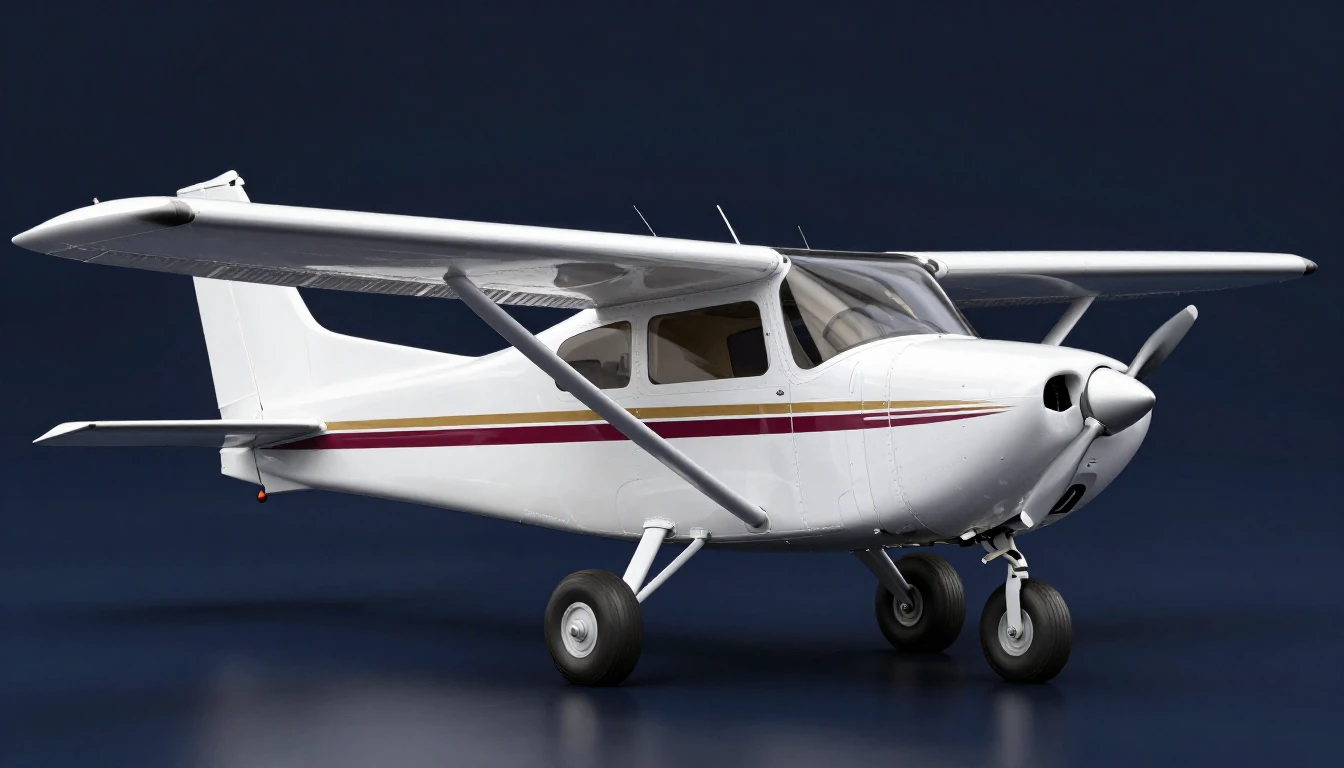
The Cessna 182T Skylane is a four-seat, high-wing single with a 230-hp Lycoming IO-540 and a constant-speed propeller. Textron lists a 145 KTAS cruise, 915 nm range and 1,110 lb useful load; its type certificate gives a 3,100 lb max takeoff weight and 87 usable gallons. US rentals run about $231 an hour.

Could you pass the PPL written today?
Free practice test from the real FAA question bank — instant score, every answer explained, no account needed.
145 KTAS
Cruise (80% power)
Textron / POH
1,110 lb
Useful load
Textron
87 gal
Usable fuel
TCDS 3A13
$231/hr
Median rental
9 US operators
Cessna 182 mission kit
What most Skylane owners actually add first
Practical add-ons for the common 182 mission: IFR travel, long legs, older panels, and owner maintenance discipline.
Noise and fatigue
Long 182 cross-countries are loud enough that ANR pays for itself quickly.
Traffic and weather
Older panels often need portable ADS-B In for ForeFlight weather and traffic.
Engine trend checks
A 230 HP engine makes oil trends and borescope discipline worth taking seriously.
Ramp and travel basics
The 182 is often a travel airplane, so portable chocks and tie-downs belong in the baggage area.
Cockpit setup
Gear guides pilots open next
Aircraft guide readers usually need practical cockpit equipment next: headset, kneeboard, ADS-B weather, and a timing setup that survives training days.
Cessna 182 specifications
Figures are for the 182T Skylane, the model in production since 2001. Each value carries the document it comes from; older Skylanes are in the by-model table.
| Dimensions | |
|---|---|
| Wingspan | 36 ft 0 in (11.0 m)[TXT] |
| Length | 29 ft 0 in (8.84 m)[TXT] |
| Height | 9 ft 4 in (2.84 m)[TXT] |
| Wing area | 174 sq ft (16.2 m²)[TXT] |
| Seats | 4[TCDS] |
| Engine | |
| Engine | Lycoming IO-540-AB1A5, fuel injected[TCDS] |
| Power | 230 hp at 2,400 rpm[TCDS] |
| Propeller | Constant speed[TCDS]More than 200 hp: a high-performance endorsement is required (14 CFR 61.31(f)). |
| Weights and fuel | |
| Max takeoff weight | 3,100 lb (1,406 kg)[TCDS, POH, TXT]Max ramp 3,110 lb. Max landing weight 2,950 lb. |
| Empty weight | 2,000 lb[TXT, POH]Textron, current equipment. The 2005 POH sample airplane is 1,924 lb. |
| Useful load | 1,110 lb[TXT, POH]Textron. 1,186 lb for the 2005 POH sample airplane. |
| Fuel capacity | 92 gal total, 87 gal usable[TCDS]The 182S has 88 gal usable. |
| Baggage | 120 lb + 80 lb, 200 lb combined[TCDS] |
| CG range | 33.0 to 46.0 in aft of datum[TCDS]Forward limit 40.9 in at 3,100 lb. |
| Performance (3,100 lb, standard day) | |
| Max speed | 150 KTAS[POH]Sea level. |
| Cruise speed | 145 KTAS[TXT, POH]80% power at 7,000 ft (Textron's headline cruise figure). |
| Range | 813 nm at 75% power / 930 nm at 55%[POH, TXT]8,000 ft and 10,000 ft, 45-minute reserve. Textron lists 915 nm. |
| Rate of climb | 924 ft/min[POH, TXT]Sea level. |
| Service ceiling | 18,100 ft[POH, TXT] |
| Takeoff distance | 795 ft ground roll / 1,514 ft over 50 ft[POH, TXT] |
| Landing distance | 590 ft ground roll / 1,350 ft over 50 ft[POH, TXT] |
| Max demonstrated crosswind | 15 kt[POH]A demonstrated value, not a limitation. |
Sources
- [POH] Cessna 182T NAV III Pilot's Operating Handbook (182TPHAUS-04, 2005), Sections 2, 3, 4 and 5
- [TCDS] FAA Type Certificate Data Sheet 3A13, Rev. 72 (September 11, 2015)
- [TXT] Textron Aviation, Cessna Skylane specifications
Performance figures are for 3,100 lb, standard day, from the 182T POH Section 5. Textron's website figures carry no stated conditions; where they differ from the POH both are shown.
Cessna 182 V-speeds
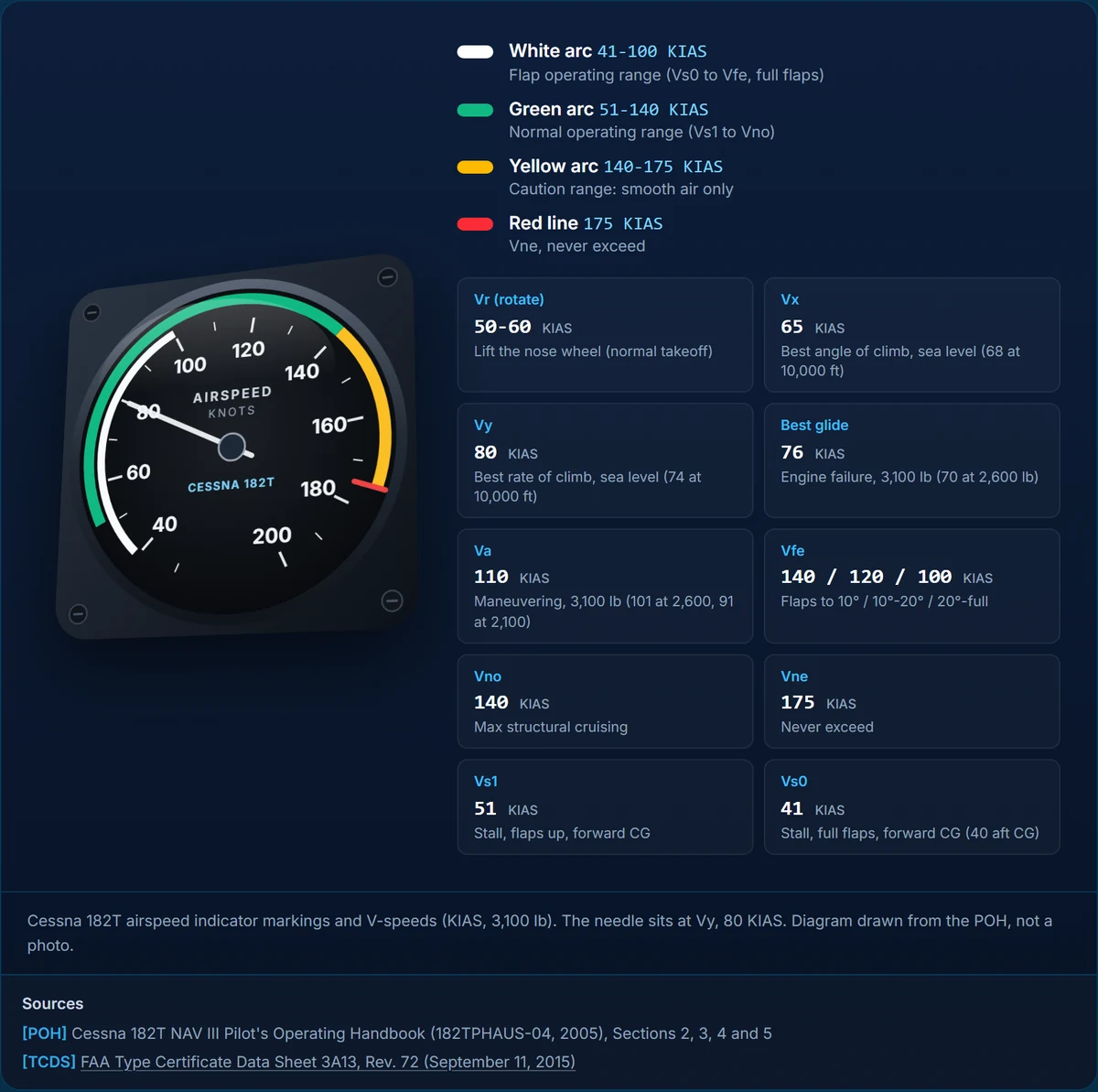
The arcs are drawn from the 182T POH airspeed indicator markings. Note the three flap limits: 140 KIAS up to 10°, 120 KIAS from 10° to 20° and 100 KIAS beyond, the top of the white arc. The type certificate lists only the 100 KIAS figure.
- White arc 41-100 KIASFlap operating range (Vs0 to Vfe, full flaps)
- Green arc 51-140 KIASNormal operating range (Vs1 to Vno)
- Yellow arc 140-175 KIASCaution range: smooth air only
- Red line 175 KIASVne, never exceed
- Vr (rotate)
- 50-60 KIAS
- Lift the nose wheel (normal takeoff)
- Vx
- 65 KIAS
- Best angle of climb, sea level (68 at 10,000 ft)
- Vy
- 80 KIAS
- Best rate of climb, sea level (74 at 10,000 ft)
- Best glide
- 76 KIAS
- Engine failure, 3,100 lb (70 at 2,600 lb)
- Va
- 110 KIAS
- Maneuvering, 3,100 lb (101 at 2,600, 91 at 2,100)
- Vfe
- 140 / 120 / 100 KIAS
- Flaps to 10° / 10°-20° / 20°-full
- Vno
- 140 KIAS
- Max structural cruising
- Vne
- 175 KIAS
- Never exceed
- Vs1
- 51 KIAS
- Stall, flaps up, forward CG
- Vs0
- 41 KIAS
- Stall, full flaps, forward CG (40 aft CG)
Sources
- [POH] Cessna 182T NAV III Pilot's Operating Handbook (182TPHAUS-04, 2005), Sections 2, 3, 4 and 5
- [TCDS] FAA Type Certificate Data Sheet 3A13, Rev. 72 (September 11, 2015)
Approach speeds from the same POH: 70-80 KIAS with flaps up, 60-70 KIAS with full flaps, and 60 KIAS for a short-field landing.
Cessna 182 limits by model
Many rental and club Skylanes are 1970s 182Ps and 182Qs, and their red line and maneuvering speed are not the 182T's. Use the column that matches the POH in your airplane.
| KIAS unless noted | 182T (2001-) | 182S (1997-2000) | 182Q (1977-80) | 182P (1976) |
|---|---|---|---|---|
| Max takeoff weight (lb) | 3,100 | — | 2,950 | 2,950 |
| Va at max weight | 110 | — | 111 | 110 CAS |
| Vfe | 140 / 120 / 100 | — | 95 | 95 CAS |
| Vno (top of green) | 140 | 140 | 143 | 141 CAS |
| Vne (red line) | 175 | 175 | 179 | 176 CAS |
| Usable fuel (gal) | 87 | 88 | 56 / 75 LR / 88* | 56 / 75 LR |
Sources
- [POH] Cessna 182T NAV III Pilot's Operating Handbook (182TPHAUS-04, 2005), Sections 2, 3, 4 and 5
- [TCDS] FAA Type Certificate Data Sheet 3A13, Rev. 72 (September 11, 2015)
182T from its 2005 POH; 182S, 182Q and 182P from FAA TCDS 3A13 Rev. 72, which lists the 1976 182P in knots CAS (earlier 182Ps differ: Vne 172, Vno 139 kt CAS). *88 gal usable with the integral tanks of 1979-80 airplanes. A dash means the value is not in the documents we checked. Always fly the POH for your serial number.
Cessna 182 fuel burn and range
The 182T POH lists cruise fuel flow by altitude, rpm and manifold pressure in Section 5. The copy we checked had unreadable cruise tables, so we do not print a single gallons-per-hour number we could not verify: plan from the table in your airplane's POH and your engine monitor.
Range from the same POH, with 87 usable gallons, a 45-minute reserve and no wind: 813 nm at 75% power and 8,000 ft, and 930 nm at 55% power and 10,000 ft. Textron's website lists 915 nm.
Turn your POH fuel flow into dollars with the fuel burn calculator.
How much it costs to rent a Cessna 182
We read the published rate sheets of 30 US schools and flying clubs on October 3, 2026. Nine listed a fixed-gear 182; the median was $231 an hour, and $222.50 among the four that state fuel is included.
| Cessna 182, fixed gear | $231/hr medianRange $150-$375 across 9 US schools and clubs. The 4 sheets that say "wet" have a $222.50 median. |
|---|---|
| Cessna 182RG (retractable) | $301.70/hr medianRange $235-$330, 3 operators. |
| Cessna 172 (for comparison) | $165/hr medianRange $105-$215 wet, 15 operators. |
Aircraft only, US dollars per flight hour, from published rate sheets read October 3, 2026. “Wet” means the sheet says fuel is included. Some clubs bill tach time (10-15% fewer hours than Hobbs) and add monthly dues. Instructor time is billed on top: $50-$125 per hour on the same rate sheets, about $80 typical.
Schools and clubs in the sample
- Aces High Aviation (Long Beach, CA)
- CP Aviation (Santa Paula, CA)
- EFI Flight School (Murrieta, CA)
- Fly Goodyear (Goodyear, AZ)
- Mountain Peaks Aviation (Ogden, UT)
- Pilot Rise (Dallas-Fort Worth, TX)
- The Flight School Inc. (Spring, TX)
- Texas Flight Aviation (Spring, TX)
- Metro Flyers Club (Denton, TX)
- St. Charles Flying Service (St. Charles, MO)
- St. Pete Air (St. Petersburg, FL)
- Rexair (Naples, FL)
- All2fly (Georgia)
- MacAir (Fort Knox, KY)
- Doylestown Airport (Doylestown, PA)
- Moore Aviation (Beaver Falls, PA)
- East Hill Flying Club (Ithaca, NY)
- Jersey Aero Club (Lakewood, NJ)
- TSS Flying Club (Washington, DC area)
- Prescott Flying Club (South St. Paul, MN)
- Skyhawk Flying Club (Omaha, NE)
- Bergstrom Aircraft (Pasco, WA)
- Eastern Cincinnati Aviation (Batavia, OH)
- Capital City Aviation (Columbus, OH)
- Fly Synergy (Illinois)
- Performance Flight (Westchester, NY)
- American Flight Schools (Colorado and California)
- Hoosier Aviation (Terre Haute, IN)
Useful load and weight
Textron lists a useful load of 1,110 lb for a current 182T. Full usable fuel, 87 gallons at 6 lb per gallon, weighs 522 lb, which leaves about 588 lb for people and baggage. Four 180-lb adults (720 lb) fit with roughly 65 gallons aboard.
Two limits matter more than in a 172: the max landing weight is 2,950 lb, 150 lb below the max takeoff weight, and the CG range runs from 33.0 to 46.0 inches aft of the datum (forward limit 40.9 inches at 3,100 lb). With only front seats occupied the 182 tends toward the forward limit; the 200 lb of baggage capacity (120 + 80 lb) helps. Use your airplane's own empty weight and moment.
Calculate your W&B: the Weight & Balance Calculator plots your CG on the envelope before you load the airplane.
Cessna 182 vs Cessna 172
The same family and the same high-wing view, with about 230 lb more useful load and 34 more usable gallons.
| 172S | 182T | |
|---|---|---|
| Engine | 180 hp, fixed-pitch prop | 230 hp, constant-speed prop |
| Max takeoff weight | 2,550 lb | 3,100 lb |
| Useful load (Textron) | 878 lb | 1,110 lb |
| Usable fuel | 53 gal | 87 gal |
| Cruise (Textron headline) | 124 KTAS | 145 KTAS |
| Service ceiling | 14,000 ft | 18,100 ft |
| Takeoff over 50 ft | 1,630 ft | 1,514 ft |
| Median rental (our sample) | $165/hr wet | $231/hr |
| Endorsement beyond the PPL | None | High-performance |
Sources: 172S and 182T POHs, FAA TCDS 3A12 and 3A13, Textron spec pages; rental medians from 15 (172) and 9 (182) US operators, October 2026. Full details in the Cessna 172 guide.
History and variants
Textron Aviation said in September 2025, at the Skylane's 70th anniversary, that more than 23,000 had been delivered.
| Year / model | What changed |
|---|---|
| 1956182 | The Skylane line starts; Textron marked 70 years in September 2025. |
| 1976-80182P / 182Q | Carbureted Continental-era Skylanes; 2,950 lb max weight. Limits in the by-model table (TCDS 3A13). |
| 1978-86Skylane RG | Retractable-gear version: a complex airplane as well as high-performance. Rents for about $301.70/hr median today. |
| 1986-96Production pause | Cessna stopped building piston singles until product-liability reform (GARA, 1994). |
| 1997182S | Production resumes with the fuel-injected Lycoming IO-540; 88 gal usable. |
| 2001182T | 3,100 lb max takeoff weight, 87 gal usable; G1000 glass cockpit from 2004-05. |
| 2017182T G1000 NXi | Textron moves the piston line, including the 182, to the G1000 NXi. |
The 172 step-up pilot
Same Cessna feel and high wing, with the load and range a 172 lacks. Plan on a checkout and the high-performance endorsement.
The family cross-country owner
1,110 lb of useful load and 87 usable gallons make four seats and real fuel workable on most days.
The IFR traveler
A heavy, stable airplane; glass 182Ts have the G1000 and, on many, the GFC 700 autopilot. Read the G1000 guide before your checkout.
The high-and-hot pilot
An 18,100 ft service ceiling and 924 ft/min climb at sea level give margin where a 172 struggles.
Flying glass? See the Garmin G1000 guide. Traveling means weather: the instrument rating exam prep covers the written that comes first.
Cost to buy a Cessna 182
Rough asking-price ranges seen in 2025-2026 listings, not appraisals. Engine time, avionics and damage history move a specific airplane far outside these bands; get a pre-buy inspection and a current price guide before you offer.
| Era / model | Asking price | Notes |
|---|---|---|
| 1960s models | $55,000 - $95,000 | Older panels; watch for corrosion and engine time. |
| 1970s (182P / 182Q) | $90,000 - $170,000 | Plentiful on the used market and well supported. |
| Skylane RG (1978-86) | $120,000 - $200,000 | Faster, but gear-system maintenance and insurance cost more. |
| 1997-2004 (182S / early 182T) | $220,000 - $340,000 | Fuel injection; round gauges or early glass. |
| 2005 and newer (182T G1000) | $300,000 and up | Glass cockpit; autopilot on many. |
Common issues and maintenance
Nose-heavy landings
The 182 carries more weight on the nose than a 172. Pilots transitioning often flare too little and land nosewheel-first; repeated hard nose landings can damage the firewall. Check it on any pre-buy.
Seat rail AD (AD 2011-10-09)
Like other single-engine Cessnas, the 182 is covered by the seat-rail AD. Make sure the seat locks before every takeoff.
Older engine cylinders
Pre-1986 Skylanes are getting old; borescope inspections and oil-analysis trends are worth more than the logbook's hours alone.
Propeller and governor
The constant-speed propeller and governor need periodic overhaul and have their own service bulletins and ADs. A prop strike means an engine inspection: check the logs.
Skylane RG gear system
The retractable gear's hydraulic system adds maintenance items and the gear-up risk that fixed-gear owners never face.
Exhaust and carbon monoxide
Muffler cracks feed CO into cabin heat. Inspect the exhaust at every annual and carry a CO detector.
Gear for the Cessna 182 Skylane
The kit that actually rides along in a Cessna 182 Skylane — picked from what trainers and owners already use.
Cessna 182 FAQ
What are the Cessna 182 V-speeds?
For the 182T the 2005 POH gives: rotate 50-60 KIAS, Vx 65, Vy 80 at sea level, best glide 76 at 3,100 lb, Va 110 at 3,100 lb (101 at 2,600, 91 at 2,100), Vfe 140 up to 10° of flap, 120 from 10° to 20° and 100 beyond, Vno 140, Vne 175, and stall speeds of 51 KIAS clean and 41 KIAS with full flaps at forward CG. Older 182P and 182Q limits are different; see the by-model table.
How fast does a Cessna 182 fly?
Textron lists a 145 KTAS cruise for the 182T, which matches the POH at 80% power and 7,000 ft; the POH's maximum speed is 150 KTAS at sea level. Vno is 140 KIAS and Vne 175 KIAS.
How much does it cost to rent a Cessna 182?
On the published rate sheets we read on October 3, 2026, a fixed-gear Cessna 182 rented for $150 to $375 an hour, with a median of $231 across nine US operators (and $222.50 among the four sheets that state fuel is included). A 182RG was $235 to $330. Expect a checkout and a high-performance endorsement first.
What is the useful load of a Cessna 182?
Textron lists 1,110 lb for a current 182T. Full usable fuel, 87 gallons at 6 lb per gallon, weighs 522 lb, which leaves about 588 lb for people and bags. Four 180-lb adults need the fuel cut to roughly 65 gallons. Use your airplane's actual empty weight from its weight and balance record.
How far can a Cessna 182 fly?
The 182T POH gives 813 nautical miles at 75% power and 8,000 ft and 930 nm at 55% power and 10,000 ft, both with a 45-minute reserve and no wind. Textron rounds its range figure to 915 nm.
What endorsement do you need to fly a Cessna 182?
The fixed-gear 182 has more than 200 horsepower, so you need a one-time high-performance endorsement from an instructor (14 CFR 61.31(f)). It is not a complex airplane because the gear is fixed; the retractable 182RG is both high-performance and complex (61.31(e)).
What is the max crosswind for a Cessna 182?
The maximum demonstrated crosswind velocity in the 182T POH is 15 knots. It is a tested value, not a structural limit.
What is the stall speed of a Cessna 182?
At 3,100 lb and forward CG the 182T POH lists 51 KIAS with flaps up and 41 KIAS with full flaps (40 KIAS at aft CG), wings level. Those match the bottoms of the green (51) and white (41) arcs.
How many Cessna 182s have been built?
Textron Aviation said in September 2025, at the Skylane's 70th anniversary, that more than 23,000 had been delivered.
Cessna 182 vs Cessna 172: what is the difference?
Compared with a 172S, the 182T has 230 hp instead of 180, a constant-speed propeller, a 3,100 lb max takeoff weight instead of 2,550, 1,110 lb of useful load instead of 878, 87 usable gallons instead of 53, and Textron cruise figures of 145 KTAS instead of 124. It costs more to rent ($231 vs $165 median in our sample) and needs a high-performance endorsement.
Compare the aircraft guides
Same format in every guide: spec tables with their sources, V-speeds from the POH and rental costs measured on real rate sheets.
Cessna 152
2 seats · high wing · fixed gear · 110 hp
Cessna 172 Skyhawk
4 seats · high wing · fixed gear · 180 hp (172S)
Piper PA-28 Cherokee
4 seats · low wing · fixed gear · 140-180 hp
Cessna 182 Skylane You are here
4 seats · high wing · fixed gear · 230 hp (182T)
Mooney M20
4 seats · low wing · retractable gear
Cirrus SR22
Low wing · fixed gear · 310 hp · airframe parachute (CAPS)
Beechcraft Bonanza
6 seats (G36) · low wing · retractable gear · 300 hp
Garmin G1000
Glass cockpit: PFD, MFD and the knobs that run them
Studying for Your Checkride or Transition?
Study with 1,800+ practice questions, flashcards, and interactive flight tools built for student, private, and instrument pilots. Pass your checkride with confidence.
$39 covers all 5 exam tracks for 60 days — or start free, no card required.